
A practical guide for sports organisations commissioning international broadcast production — from scope definition to post-event archive delivery.
I have spent more than ten years producing and managing broadcast for international sports events — from national league livestreams to European and World Championships distributed through FIBA, LEN, CEV, and World Aquatics. In that time I have seen the same planning failures repeat across organisations of every size: briefs that arrive without a defined scope, venues surveyed too late to fix what is found, rights holders whose technical requirements are discovered during the build rather than at the tender stage.
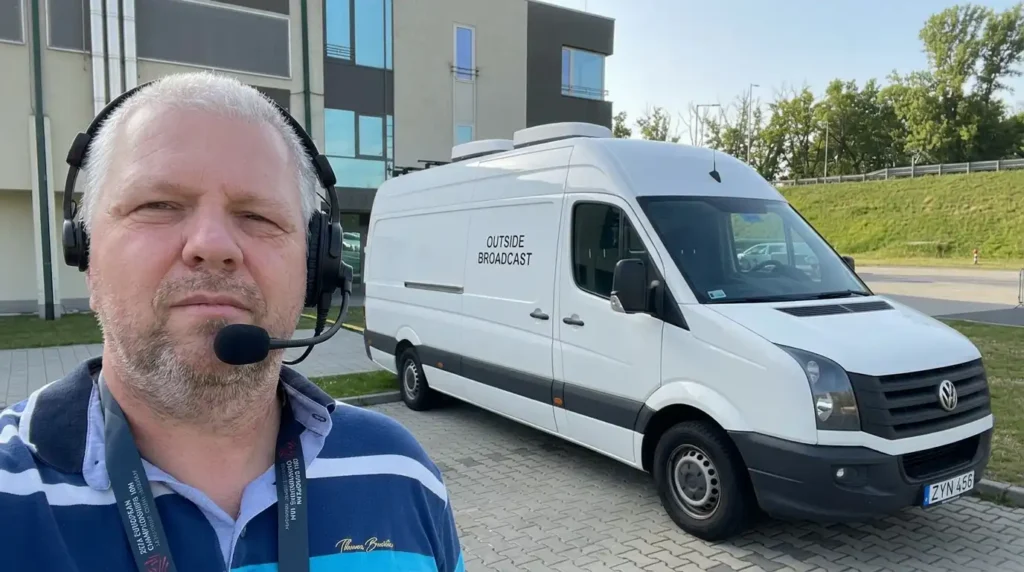
This guide is the knowledge I use every time I take on a broadcast management role. It is structured around the decisions a federation or event organiser must make — and the sequence in which those decisions must be made — to commission a broadcast production that delivers what was intended.
Péli László — broadcast producer and host broadcast manager, Pélicom Média
Guide contents
Chapter 1: Defining the broadcast scope before tendering
The most expensive planning mistake in broadcast production happens before a single vendor is contacted. How to define the scope — primary output, rights obligations, contractual minimums — before the tender goes out.
Chapter 2: What a broadcast mandate document should contain
The seven sections that every broadcast mandate must contain — from rights identification and output format specifications to failure protocols. Who should write it, and when.
Chapter 3: The broadcast production timeline for international sports events
Eight milestones from scope definition to post-event archive delivery. What happens at each stage, who owns it, and what goes wrong when the timeline is compressed.
Chapter 4: Venue assessment for international sports broadcast
Six areas a venue technical survey must cover — camera positions, power, connectivity, compound, commentary, and accreditation. Why a floor plan is not a substitute for a physical survey.
Chapter 5: Production logistics for international sports broadcast
Build, wrap, and venue coordination. Loading access, power connection, AV handover, accreditation submission, and the wrap plan — the operational layer that determines whether the production plan survives contact with reality.
Chapter 6: Coordinating broadcast with venue AV, lighting and LED systems
Audio feeds, IFB, lighting freeze states, LED refresh rates, and rights in LED content. Why these systems must be specified to broadcast requirements before the build — not resolved during it.
Chapter 7: Connectivity requirements for international sports broadcast
Upload bandwidth, latency, jitter, packet loss — what broadcast transmission actually requires, and why download speed is the wrong metric. Dedicated fibre, SRT over broadband, bonded cellular, and what should never be used as a primary broadcast connection.
Chapter 8: Feed architecture for international sports broadcast
World feed, clean international feed, domestic feed, streaming and social feeds. How to design the feed architecture before the production is designed — and why every downstream decision depends on it.
Chapter 9: Rights platform strategy for sports broadcast
Free-to-air television, pay platforms, federation-owned channels, multi-platform distribution. Why platform selection is a rights decision — and what federations give away when they treat it as a technical afterthought.
Chapter 10: Audience ownership in sports broadcast
Why federations must own the relationship with their broadcast audience — and what they lose when they stream through third-party channels without a strategy for audience capture.
Chapter 11: Archive and delivery specifications for broadcast rights holders
Format, codec, frame rate, naming conventions, and delivery timelines. The archive specifications that federations under-specify — and discover the problem when they need the footage.
Chapter 12: How to write a broadcast production brief that actually works
The production brief that generates comparable, accurate bids — and the brief that generates confusion. Structure, language, and the distinction between obligations and ambitions.
Chapter 13: Measuring broadcast performance — KPIs for sports rights holders
Total viewing time, unique viewers, per-viewer engagement. The metrics that reveal whether a broadcast is performing — and why click counts tell you almost nothing.
Chapter 14: Maximising content value after the event
Archive repurposing, highlight production, sublicensing, and social cutdowns. How to extract broadcast value that extends beyond the live window — and why it starts with the archive specification, not the edit.
About the author
Péli László has produced and managed broadcast for international sports events for over ten years, including European and World Championships in swimming, water polo, volleyball, shooting, table tennis, and boxing for federations including FIBA, LEN, CEV, and World Aquatics. He has worked as host broadcast manager on events distributed through Antenna Hungária, M4 Sport, Sport TV, Sportradar, DAZN, and Laola TV. He operates as broadcast producer and host broadcast manager through Pélicom Média, based in Budapest.
Frequently asked questions
What is sports broadcast management?
Sports broadcast management is the discipline of planning, commissioning, and overseeing the broadcast production of sports events on behalf of the rights holder — typically a federation, league, or event organiser. It covers scope definition, mandate writing, vendor selection, production oversight, rights holder coordination, and delivery. It is distinct from broadcast production, which is the technical execution of the broadcast, and from broadcast rights, which is the commercial licensing of content.
What is a host broadcaster in international sports?
The host broadcaster is the entity responsible for producing the primary broadcast signal of an international sports event — the world feed that is distributed to rights holders globally. In some cases the federation acts as its own host broadcaster, commissioning a production company to execute the production. In others, a national broadcaster or specialist production company is appointed as host broadcaster under a specific rights or service agreement.
How far in advance should a sports federation start planning its broadcast?
For international events with television rights holders, broadcast scope definition should begin 12 to 16 weeks before the event. The broadcast mandate document should be finalised and vendor tendering should begin no later than 10 weeks before. The production partner should be confirmed at least 8 weeks before the event. Events with satellite transmission requirements, multiple simultaneous feeds, or complex rights structures should begin planning earlier.
What does a broadcast manager do for a sports federation?
A broadcast manager acting on behalf of a federation defines the broadcast scope, writes or reviews the broadcast mandate document, manages the vendor tendering process, coordinates between the production partner and the federation’s event operations team, oversees rights holder technical requirements, monitors production compliance during the event, and manages post-event archive delivery. The broadcast manager represents the federation’s interests in all production decisions — as distinct from the production company, which represents the execution of those decisions.
What is the difference between a broadcast mandate and a production brief?
A production brief describes what a sports federation wants from the production. A broadcast mandate defines what is contractually obligated — the minimum deliverables, technical specifications, and rights holder requirements that the production must meet. The mandate is the document against which delivery can be assessed and if necessary disputed. A brief is aspirational; a mandate is enforceable. Both are necessary; they serve different functions and should not be conflated.
Planning a broadcast for your next event?