
Sports Broadcast Management Guide · Chapter 12 of 14 · videoteamhungary.com
A production brief that generates comparable, accurate bids from experienced vendors is a specific document. It is not a form filled in from memory, not a short email with the event date and a request for a quote, and not a repackaged version of last year’s brief with the dates changed. The brief is the federation’s only communication with vendors before they commit to a price and a scope. If the brief is unclear, incomplete, or conflates obligations with ambitions, every vendor will solve a slightly different problem — and the federation will receive bids it cannot meaningfully compare.
What a production brief is — and is not
A production brief describes what the federation wants from the production. It is different from the broadcast mandate, which defines what is obligated. The brief is the document that goes to vendors during tendering. The mandate is the document that governs the contract.
A brief that functions as a mandate — written with contractual language, specifying delivery obligations before a vendor has been selected — is premature. It assumes the production structure before receiving the vendor’s input, and often specifies technical solutions that a more experienced vendor would solve differently. The brief should describe outcomes and requirements. The mandate translates those requirements into obligations once the vendor is selected and the production structure is agreed.
The eight elements of a brief that generates accurate bids
1. Event description and context
Describe the event: sport, format, number of sessions, venue, expected attendance, and the event’s position within the federation’s calendar. Include whether this is a standalone event or part of a series, whether it has been broadcast before and what the previous production looked like, and any context about the federation’s broadcast development trajectory that would help a vendor understand what this production is trying to achieve.
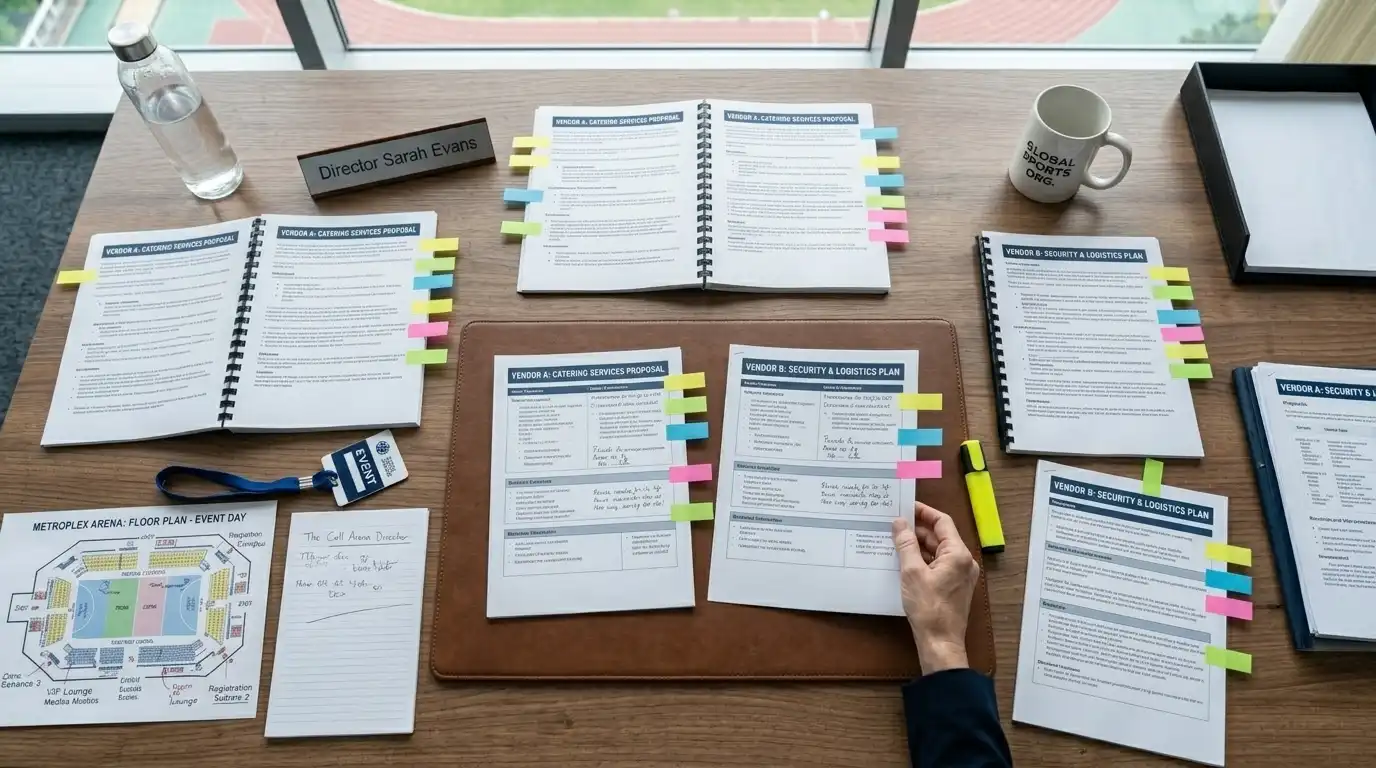
Vendors who understand the event’s context can design a production that is appropriate for its scale and ambitions. Vendors who receive only a date and a venue will design to their default, which may over-engineer or under-serve the federation’s actual needs.
2. Rights holders and distribution requirements
Specify who will receive a broadcast feed: domestic broadcaster, international streaming platform, federation-owned channel, or a combination. For each rights holder, state whether they require a live feed, a delayed feed, or both, and whether they have specified technical delivery requirements. If a rights holder’s technical specifications are known, attach them or summarise the key parameters. A vendor designing a production for a single YouTube stream and a vendor designing for simultaneous delivery to a domestic broadcaster and an international contribution uplink will produce significantly different cost structures and technical designs.
3. Output format requirements
State the primary output format: resolution, frame rate, whether a clean international feed without graphics is required alongside the main programme output. If the federation has a preference for the transmission method — dedicated fibre, SRT over broadband, satellite uplink — state it here, or explicitly ask vendors to propose the appropriate method for the venue and the rights holder requirements. Do not specify technical solutions the federation is not qualified to specify. Ask vendors to justify their technical choices.
4. Editorial requirements and coverage intent
Describe what the broadcast should show — not how many cameras should be used, but what the viewer should experience. Is the primary coverage the full competition field, or individual athlete tracking? Is there pre-match and post-match coverage? Are there specific moments — medal ceremonies, athlete reactions, post-event interviews — that must be in the production plan? Providing a reference broadcast — a link to a comparable event from a comparable federation — is more useful than a camera count. It allows the vendor to understand the editorial intent and propose a production structure that delivers it.
5. Graphics and presentation requirements
Specify the graphics elements required: score display, clock, lower-thirds for athlete identification, replay indicator, sponsor integration. If the federation has existing brand guidelines that govern on-screen presentation, attach them. If there are specific sponsor integration requirements — sponsor logos in defined positions, naming rights for specific graphical elements — state them here. Graphics are a significant component of production cost and timeline. Underspecifying them in the brief leads to bids that do not include the full graphics requirement.
6. Venue information and access constraints
Provide the venue name, address, and any known technical information: available internet connectivity, power infrastructure, existing broadcast infrastructure from previous events. State whether a venue survey has been conducted and, if so, provide the survey output document. If no survey has been conducted, state this explicitly — experienced vendors will include a venue survey in their bid, and the brief should confirm this is expected. Withholding venue information from vendors produces bids built on assumptions that will be corrected during the build at the federation’s cost.
7. Archive and delivery requirements
State what archive deliverables are required: production master, ISO recordings, clean feed recording, highlights edit. For each, specify the format, the delivery timeline, and the delivery method. If the federation requires the rights to the recorded material, state this explicitly — it is a negotiating point, not an assumption, and vendors need to know it is in scope before they price the brief.
8. Budget range and evaluation criteria
Stating a budget range is not a negotiating weakness. It is information that allows vendors to design an appropriate production rather than either over-engineering a solution that exceeds budget or under-engineering one that fails to meet requirements. Vendors who receive no budget guidance will design to their default scale, which may not match the federation’s expectation. The evaluation criteria — how bids will be assessed — should also be stated: whether price, technical quality, experience with comparable events, or a combination will determine selection.
What the brief should not contain
The brief should not specify the number of cameras or their positions unless the federation has a specific contractual or editorial reason for a fixed requirement. Camera count and placement are production design decisions that vendors are better placed to make than federations. A brief that specifies four cameras when the production requires six will receive bids for four cameras — and a production that underdelivers.
The brief should not specify equipment brands or models unless there is a specific technical reason — for example, compatibility with an existing federation system. Requiring a specific encoder brand limits the vendor pool and may exclude more capable solutions.
The brief should not include undefined aspirations. Phrases like “high production values” or “professional quality” are not specifications — they are noise that experienced vendors will ignore and inexperienced vendors will interpret differently from each other. Describe what you want to see on screen and let vendors propose how to achieve it.
Frequently asked questions
How long should a broadcast production brief be?
Long enough to answer all eight questions above clearly, short enough to be read in full by a vendor assessing whether to bid. For most sports events, a well-structured brief of four to six pages covers the necessary ground. Longer briefs are not more thorough — they are often less useful, because the critical requirements are buried in material that does not affect the production design. Lead with the most important information: rights holders, output requirements, venue, and timeline.
Should the brief specify which streaming platform to use?
Only if the federation has a specific requirement or existing relationship that constrains the choice. If the federation uses a particular platform for all its events and the vendor must deliver to that platform, state it. If the choice is open, ask vendors to propose and justify a platform based on the distribution requirements. Platform recommendations from experienced vendors often reflect practical knowledge of what works for the specific rights holder or audience profile.
What is the difference between a brief and a specification?
A brief describes what the federation needs and what the broadcast should achieve. A specification defines technical parameters — signal format, audio configuration, delivery protocol — in enough detail to form contractual obligations. The brief goes to vendors during tendering. The specification is developed collaboratively between the federation and the selected vendor, and becomes part of the broadcast mandate that governs the production contract. Treating the brief as a specification produces documents that constrain vendors before the production design has been agreed.
Previous: Chapter 11: Archive and delivery specifications for broadcast rights holders · Next: Chapter 13: Measuring broadcast performance — KPIs for sports rights holders