
Sports Broadcast Management Guide · Chapter 11 of 14 · videoteamhungary.com
The broadcast ends. The production team breaks down. The event director signs off. And somewhere in a conversation that probably did not happen before the event, someone assumes someone else is handling the archive. Six months later, a federation needs footage for a sponsorship report. Or a highlights package for a rights holder. Or a clean master for sublicensing to a new market. And the archive is missing, transcoded into a format that requires expensive remediation, or held by a production company that considers it their asset rather than the federation’s.
Archive and delivery specification is the part of broadcast planning that federations most consistently under-specify. Its consequences are invisible until the moment they become expensive.
Why archive specification belongs in the broadcast mandate
The broadcast mandate defines what the production partner is obligated to deliver. If archive specifications are not in the mandate, the production partner has no obligation to deliver anything beyond the live signal — and in many standard production contracts, the recorded material is treated as the production company’s property unless the contract specifies otherwise.
Archive specification must be written into the broadcast mandate before the production is commissioned. Not agreed informally after the event. Not added to the contract as an afterthought. The specification defines format, codec, resolution, frame rate, audio configuration, naming conventions, delivery method, delivery timeline, and the rights position on the recorded material. Each of these has implications that cannot be resolved retrospectively.
The core archive deliverables
The production master
The production master is the highest-quality recording of the broadcast output — the programme mix as it was transmitted, at the maximum quality the production system can record. It is the archive asset from which all other derivatives are produced: highlights packages, social cutdowns, sublicensed versions, broadcast repeats.
The production master should be recorded independently of the transmission stream. A recording taken directly from the encoder output will reflect any quality degradation introduced by the transmission compression. A production master recorded at the source — before encoding for transmission — preserves the full quality of the original production and is the correct source for any future use of the material.
Standard specifications for a broadcast production master: 1920×1080, 50i or 25p depending on the production frame rate, ProRes 422 HQ or DNxHR HQX codec, stereo and international sound feeds as separate audio tracks, MOV or MXF container. For productions destined for television distribution, the broadcaster’s delivery specification takes precedence over any general standard.
Isolated camera recordings
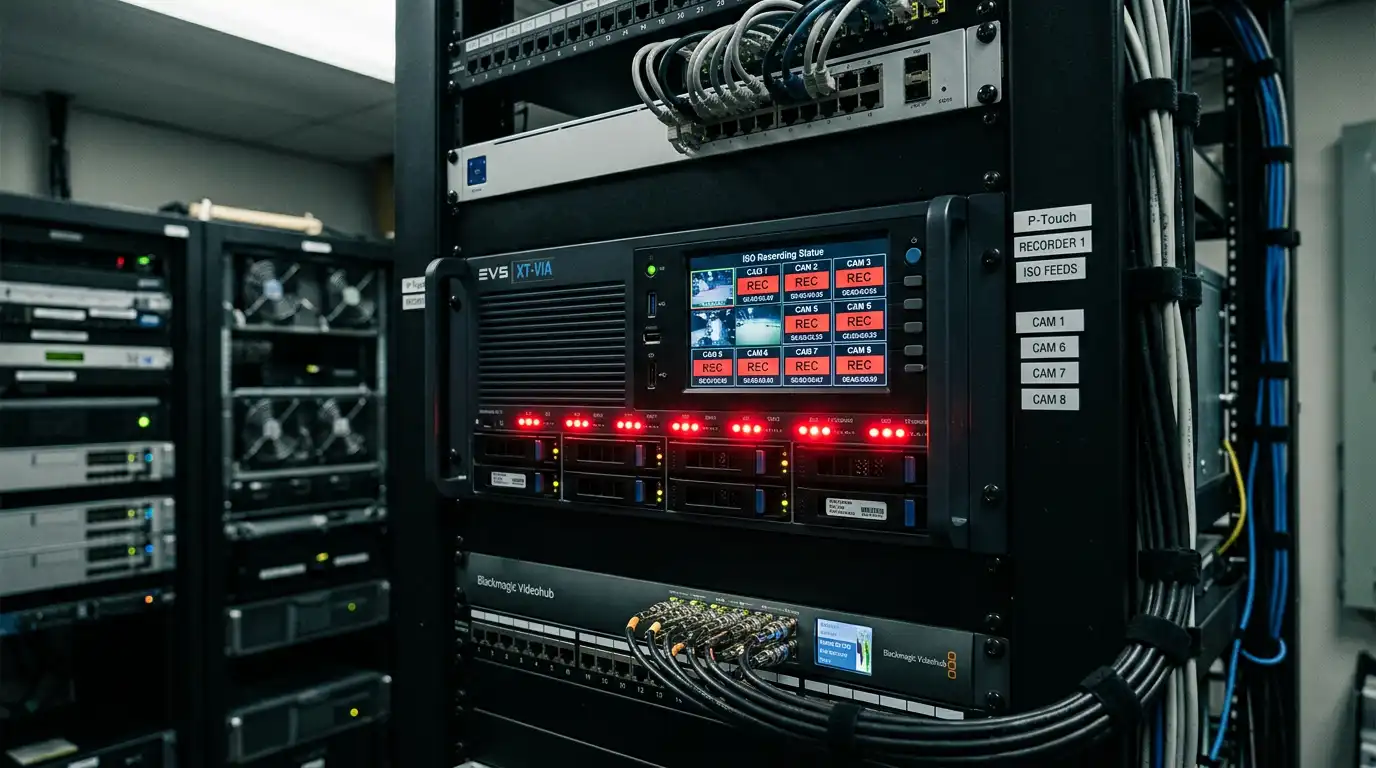
Isolated camera recordings — ISO recordings — capture each camera’s output independently of the director’s mix. They are used in post-production to create alternative edits, to extract specific athlete coverage that was not selected in the live mix, and to produce highlights packages that benefit from angles not used in the broadcast. For events where post-event content production is planned, ISO recordings are essential source material.
ISO recordings are not produced by default — they require dedicated recording capacity that must be specified in the mandate. Not all production setups include ISO recording as standard. The cost of ISO recording capacity is a known and relatively modest addition to a production budget. The cost of not having ISO recordings when they are needed for a post-production project is typically far higher.
The clean feed recording
Where a clean international feed is produced — the world feed without graphics overlays — a separate recording of this feed should be archived alongside the production master. Rights holders who acquire the broadcast after the event for repeat transmission or sublicensing will typically require the clean feed rather than the graphics version, because they will apply their own graphics package. If only the graphics version is archived, the clean version cannot be reconstructed.
The highlights edit
For events where a highlights package is contractually required — many federation broadcast agreements specify a highlights edit as a deliverable alongside the live broadcast — the specification for the highlights edit must be in the mandate. This includes duration, format requirements for each platform it will be distributed to, the deadline for delivery after the event, and the approval process for content before distribution. A highlights edit produced to the wrong specifications for its intended platform is a delivered asset that cannot be used.
Technical delivery specifications by use case
| Use case | Resolution | Frame rate | Codec | Container |
|---|---|---|---|---|
| Archive / long-term storage | 1920×1080 | 25p or 50i | h.264 at 15 Mbps minimum | MP4 or MOV |
| Post-production source | 1920×1080 | 25p or 50i | ProRes 422 or DNxHR | MOV or MXF |
| Television delivery | 1920×1080 | 50i | ProRes 422 HQ or XDCAM | MOV or MXF |
| Online / streaming platforms | 1920×1080 | 25p | h.264 at 8–12 Mbps | MP4 |
| Social media highlights | 1920×1080 or 1080×1920 | 25p | h.264 at 5–8 Mbps | MP4 |
Naming conventions and delivery organisation
Archive assets without consistent naming conventions are difficult to locate, easy to mistake for each other, and professionally embarrassing to deliver to rights holders. The broadcast mandate should specify a naming convention for all archive assets that includes: the event name and date, the asset type (programme master, ISO camera number, clean feed, highlights), and the version number if multiple versions exist.
A practical naming structure: EventName_YYYYMMDD_AssetType_Version. For example: EuropeanSwimmingChampionships_20251014_ProgrammeMaster_v1. This structure is self-describing — anyone receiving the file can identify its content without opening it — and sorts chronologically in any file system.
Delivery method and timeline
The mandate must specify how archive assets are delivered to the federation and to rights holders: cloud transfer with link and access credentials, physical media handed over at the venue, FTP or SFTP to a specified server, or a federation-managed content management system. Each method has lead time implications. Cloud transfer of a production master can begin within hours of the event ending. Physical media requires time to finalise the recording and produce physical copies. The delivery method must match the rights holder’s or federation’s technical capability to receive it.
The delivery timeline should be specified as a hard deadline in the mandate: for example, the production master delivered within 48 hours of the event ending, ISO recordings within five working days. These deadlines should be negotiated with the production partner at the contracting stage, not requested after the event when the production team has demobilised.
Frequently asked questions
Who owns the broadcast recording after a sports event?
Ownership of the broadcast recording depends on the contract between the federation and the production company. In the absence of specific contractual terms, copyright in an audiovisual work typically vests in the producer — the production company. Federations that do not explicitly contract for ownership or exclusive usage rights to the broadcast recording may find that the production company holds the copyright and can restrict or charge for the federation’s use of the footage. The broadcast mandate and production contract must specify the rights position clearly.
What is the difference between a production master and an archive copy?
A production master is the highest-quality recording of the broadcast, produced at the source before any transmission encoding. An archive copy is typically a compressed version of the broadcast at a quality level sufficient for long-term storage and future use, but lower than the production master. For most federation purposes, a high-quality h.264 archive copy is adequate for storage. For post-production work — highlights editing, sublicensing to broadcasters, repeat transmission — the production master is the appropriate source material.
What are ISO recordings and when are they needed?
ISO recordings are independent recordings of each camera’s output, captured alongside the director’s mixed programme output. They are needed when post-event content production requires access to coverage that was not selected in the live mix — athlete close-ups, alternative angles, coverage from camera positions that were not cut to during the broadcast. For federations producing highlights packages, social content, or educational material from their events, ISO recordings significantly expand the available source material.
Previous: Chapter 10: Audience ownership in sports broadcast · Next: Chapter 12: How to write a broadcast production brief that actually works