
Sports Broadcast Management Guide · Chapter 2 of 14 · videoteamhungary.com
The broadcast mandate is the single most important document in any international sports production. Most federations either do not have one, or have one that fails at the moment it is needed most.
What a broadcast mandate document actually is
A broadcast mandate document is the contractual and technical foundation of an international sports production. It defines in unambiguous terms what the host broadcaster or production partner is required to deliver, to whom, in what format, and under what conditions.
It is not a production brief. A production brief describes what you want. A mandate document describes what is obligated and the distinction matters when something goes wrong, when a rights holder disputes delivery, or when a venue fails to provide agreed access.
In practice, the mandate serves three parallel functions: it is an operational checklist for the production team, a technical specification for downstream rights holders, and a legal reference document if delivery is disputed. A document that cannot serve all three functions simultaneously is incomplete.
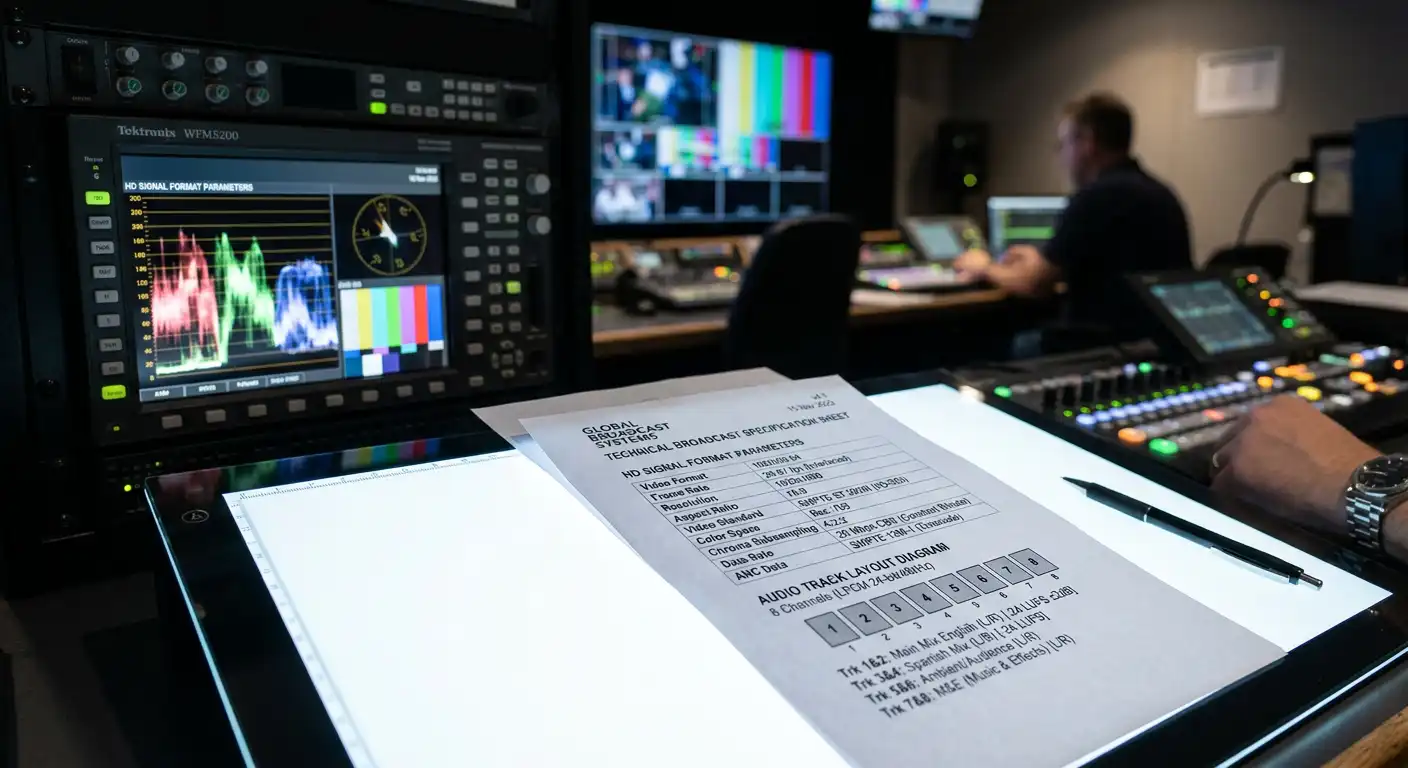
Federations that conflate the mandate with the production brief create a document that is useful for one conversation but fails in the others. The mandate must be written with the rights holder and the dispute arbitrator in mind, not just the camera operator.
The seven sections a broadcast mandate must contain
The following structure reflects international practice across federation-level productions. The weight and detail of each section varies by event scale, but all seven must be present in some form, even for smaller national-level events with a single rights holder.
Section 1: Event and rights ownership identification
The document must open by clearly identifying the event, the federation as rights holder, and the scope of rights being exercised. This includes the full event name, dates, venue, and the geographic scope of the rights being produced under this mandate. A production for a Central European championship may require separate feeds for domestic broadcast, international sublicensing, and the federation’s own digital platforms. Each is a separate obligation and should be identified here, not embedded later in technical sections.
Section 2: Output format specifications
This is the most technically dense section and the one most often written incorrectly. It must specify: signal format (HD 1080i/50 or 1080p/25/50), aspect ratio, audio configuration (stereo, 5.1, international sound feed requirements), embedded versus discrete audio, and colour space. For events where a clean international feed is required without graphics, commentary, or score overlays, this must be explicitly stated as a separate deliverable from any domestic broadcast output.
Downstream rights holders, including broadcasters receiving the signal via Sportradar, Eurovision, or direct uplink, will have their own technical acceptance specifications. The mandate should reference these, or require the production partner to obtain and confirm compliance with them before the event.
Section 3: Camera positions and minimum coverage requirements
The mandate specifies the minimum number of cameras, their mandatory positions, and any positions that are subject to venue-dependent placement. For team sports with federation-level technical regulations such as FIBA, CEV, or World Aquatics, the relevant technical appendix from the parent body should be referenced or attached directly. For events without a parent federation standard, the mandate must define its own minimum: at minimum one main camera on the central axis, one wide establishing shot, and one close-up position for athlete presentation and medal ceremonies.
Camera position requirements also determine access rights at the venue. The mandate should cross-reference the accreditation section. If a camera position is listed as mandatory, the corresponding accreditation and power access must be guaranteed by the venue and documented in writing before the event contract is signed.
Section 4: Commentary and presentation infrastructure
International events require commentary positions for rights-holding broadcasters who attend in person. The mandate must specify the number of positions available, the technical connectivity at each position (IFB, programme feed, talkback, power), and the booking process for unilateral positions used exclusively by one broadcaster for their own camera and commentary operation.
The international sound feed, a programme mix without commentary, must be defined here as a mandatory deliverable if any rights holder will be adding their own commentary in post or at their own facility. Omitting this requirement from the mandate is one of the most common and costly errors in federation-level production planning.
Section 5: Transmission and delivery obligations
How the signal leaves the venue is as important as how it is produced. The mandate must specify the primary transmission method (satellite uplink, fibre contribution, IP/SRT, or a combination) and identify who is responsible for each segment of the signal chain. It must name the uplink point of contact, the contribution path destination, and the technical contacts at receiving facilities.
For events in Central Europe where satellite uplink infrastructure is less concentrated than in Western European markets, this section requires particular attention. Antenna Hungaria operates the primary uplink infrastructure in Hungary. If the production will use this path, the mandate should reference the technical specifications and booking procedures relevant to that relationship rather than leaving them to be resolved during production week.
Section 6: Archive and file delivery requirements
Not all rights holders consume the production live. The mandate must define the archive deliverables: format, codec, frame rate, and naming conventions for all recorded assets. It must specify whether the archive includes isolated camera recordings, whether a production master is required separately from the programme mix, and the delivery timeline for when assets must be available after the event ends.
Federations that have historically under-specified this section discover the problem when they attempt to use archived footage for future productions, sponsorship packages, or sublicensing and find the files are in a format that requires expensive transcoding, or are missing entirely because they were never contractually required.
Section 7: Escalation, change management, and failure protocols
The mandate must specify what happens when something does not go as planned. This includes the escalation chain for technical failures during transmission, the procedure for logging and reporting production deviations, the threshold at which a failure constitutes a delivery shortfall under the rights agreement, and the contacts responsible for each decision level during the live event.
This section is rarely written because it requires contemplating failure, which is uncomfortable in the optimistic context of event planning. It is however the section that determines whether a technical incident becomes a manageable event or a contractual dispute. A broadcast manager with experience across multiple federation events will have seen each failure mode at least once and can draft this section from experience rather than from theory.
A reference structure at a glance
| Section | Key question it answers | Who uses it |
|---|---|---|
| 1 · Rights identification | What event, which rights, whose obligations? | Legal, federation exec |
| 2 · Output formats | What does the signal look like at delivery? | Production, rights holders |
| 3 · Camera positions | What must be covered and from where? | Director, venue, accreditation |
| 4 · Commentary infrastructure | How do attending broadcasters operate? | Broadcasters, production |
| 5 · Transmission | How does the signal leave the venue? | Technical, uplink operator |
| 6 · Archive delivery | What is recorded, in what format, when? | Federation, post-production |
| 7 · Failure protocols | Who decides what when something goes wrong? | Everyone, at the worst time |
Who should write the mandate and when
The mandate should be drafted by someone with working knowledge of all seven sections, not by a federation administrator filling in a template, and not by the production company that will be bound by it. The conflict of interest in the latter case is obvious: a production company asked to write its own mandate will write obligations it knows it can meet rather than obligations the rights holders actually need.
The appropriate author is a broadcast manager acting on behalf of the federation, someone who understands the rights agreements on one side and the production constraints on the other, and whose interest is alignment rather than self-protection. The mandate should be complete before vendor tendering begins. Not during. Not after.
Frequently asked questions
What is a broadcast mandate document in international sports?
A broadcast mandate document defines what a host broadcaster or production partner must deliver for an international sports event: signal format, camera requirements, commentary infrastructure, transmission method, archive specifications, and failure protocols. It serves simultaneously as an operational checklist, a technical specification, and a legal reference document.
What is the difference between a broadcast mandate and a production brief?
A production brief describes what you want from a production. A broadcast mandate describes what is contractually obligated. The mandate is binding and defines delivery standards against which the production can be assessed and if necessary disputed. A brief is aspirational; a mandate is enforceable.
What should a broadcast mandate document include?
Seven sections: rights and event identification, output format specifications, minimum camera positions and coverage requirements, commentary and presentation infrastructure, transmission and delivery obligations, archive and file delivery requirements, and escalation and failure protocols. All seven must be present even in scaled-down form for the document to be operationally complete.
Who should write a broadcast mandate for a sports federation?
A broadcast manager acting on behalf of the federation, someone independent of the production company that will be bound by the document. The mandate should be finalized before vendor tendering begins, not during or after. Writing the mandate and then tendering against it is the correct sequence; doing them simultaneously creates incentives for scope reduction.
What is an international sound feed and why does the broadcast mandate need to specify it?
An international sound feed is a programme audio mix that contains venue sound and natural atmosphere but no commentary. It is required by any rights holder who will add their own language commentary either live or in post-production. If the mandate does not explicitly list it as a deliverable, the production company has no obligation to provide it, and obtaining it after the event is impossible.
Does a small sports federation need a broadcast mandate document?
Yes, if the event has any broadcast obligations even with a single domestic television partner. The scale of the document can be proportional to the event: a single-feed domestic production needs a shorter mandate than a multi-rights-holder international championship. But the core structure applies at every scale.
Previous: Chapter 1: Defining the broadcast scope before tendering – Next in this series: Chapter 3: The broadcast production timeline for international sports events