
Sports Broadcast Management Guide · Chapter 13 of 14 · videoteamhungary.com
A broadcast that nobody watches is not a broadcast. It is a production cost with no return. Yet most sports federations measure their broadcast performance with the same number they would use to evaluate a social media post: total views. Total views is not a performance metric. It is a count. The difference between a count and a metric is that a metric tells you something actionable. A view count tells you how many times the player was started. A broadcast performance framework tells you whether the broadcast is building the sport’s media value or merely recording its existence.
The three metrics that actually matter
Total viewing time
Total viewing time is the aggregate of all viewing time across all viewers for a broadcast or event. If 1,000 viewers each watched for an average of 45 minutes, the total viewing time is 750 hours. This metric captures the actual engagement with the broadcast — not how many times it was started, but how much of it was watched.
Total viewing time is the primary metric used by broadcasters and streaming platforms to assess content value. It is what rights fees are ultimately based on. A federation that can demonstrate growing total viewing time across its events is demonstrating growing broadcast value — which translates directly into rights negotiating leverage. A federation that can only report view counts cannot make this case, because a view count is compatible with an audience that starts the broadcast and immediately leaves.
Average viewing duration per viewer
Average viewing duration per viewer is total viewing time divided by the number of unique viewers. For a sports event with a known total duration — a 90-minute match, a two-hour championship session — this metric reveals what proportion of the available broadcast the average viewer actually consumed.
An average viewing duration that is a high proportion of the event duration indicates genuine audience engagement — viewers who came to watch the event, not viewers who started the stream and left. An average viewing duration that is low relative to the event duration indicates either a promotion problem (the audience arrived expecting something different), a quality problem (the broadcast failed to hold attention), or a technical problem (buffering, latency, or signal failure caused viewers to abandon).
The ratio between these two failure modes matters for decision-making. High unique viewer count with low average duration points to promotion and expectation-setting. Low unique viewer count with high average duration points to distribution reach. Conflating them into a single view count number makes it impossible to identify which problem you are solving.
Unique viewer count
Unique viewer count is the number of individual viewers who started the broadcast. It measures reach — how many people found the broadcast and chose to start watching. It is a useful metric for assessing the effectiveness of promotion and distribution, but it is not a measure of broadcast value on its own. A broadcast watched by 10,000 people for an average of 30 seconds is not more valuable than one watched by 1,000 people for an average of 60 minutes, even though the view count is ten times higher.
Secondary metrics worth tracking
Peak concurrent viewers
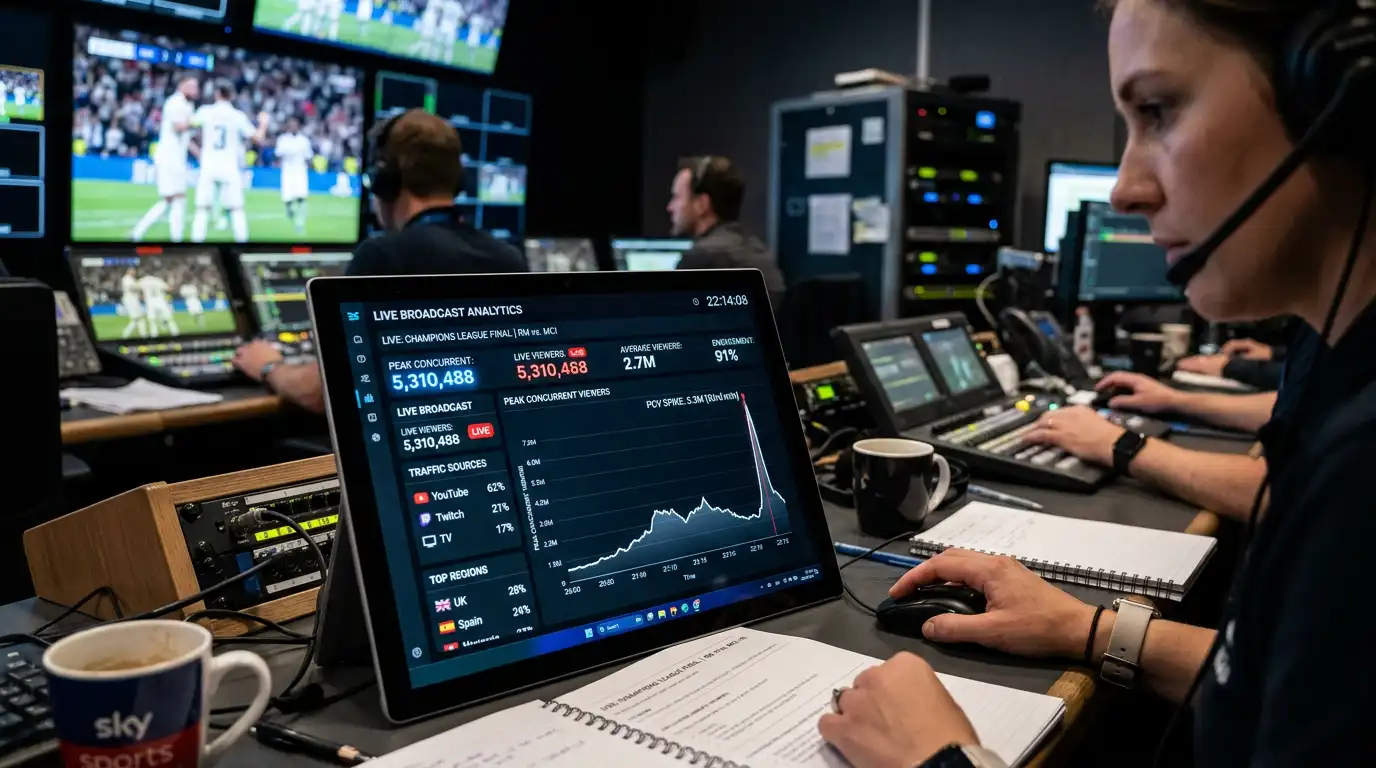
Peak concurrent viewers — the maximum number of viewers watching simultaneously at any point during the broadcast — is the closest streaming equivalent to a television audience rating. It captures the event’s live broadcast moment at its peak, which is typically at the most contested or dramatic point of the competition. For rights negotiations, peak concurrent viewers is often more persuasive than average viewing numbers because it reflects the event at its maximum broadcast value.
Geographic distribution
Geographic distribution of viewers identifies which territories are watching and in what volume. For federations with international rights, this data reveals which markets are engaged and which are underserved — information that directly informs rights licensing strategy. A federation that discovers significant viewership in a territory without a rights holder has identified a potential licensing opportunity. A territory with a rights holder but low viewership indicates a distribution or promotion problem that the rights agreement may need to address.
Platform and device breakdown
Understanding which platforms and devices viewers use informs future distribution decisions. A broadcast audience that is predominantly mobile suggests different platform and format priorities than one that is predominantly connected television. This data also informs the federation’s owned channel strategy — if the audience is primarily consuming on YouTube via mobile, that affects decisions about vertical format content, thumbnail design, and title formatting.
Metrics that do not measure broadcast performance
Page views and link clicks count how many times a page containing a broadcast player was loaded or a link to a broadcast was followed. They do not indicate whether the broadcast was watched, for how long, or whether the viewer experience was satisfactory. Federations that report these numbers as broadcast performance metrics are measuring their website traffic, not their broadcast.
Social media impressions count how many times a post about a broadcast appeared in a feed. They are a measure of potential reach, not actual viewership. An impression is not a viewer. A broadcast that generated 500,000 impressions but 200 actual viewers with a 45-second average duration has a social media reach problem and a broadcast quality problem — neither of which is visible from the impression count alone.
How to obtain the right data
Viewing time and unique viewer data are available from most broadcast and streaming platforms, but the availability and granularity of the data varies significantly. YouTube Studio provides total watch time, average view duration, and unique viewers for content on the federation’s own channel. Third-party streaming platforms — Sportradar, Laola TV, federation OTT platforms — typically provide viewership reports on request, but the specific metrics available depend on the platform and the rights agreement.
For broadcasts distributed through television rights holders, audience data is typically provided by the broadcaster’s research department or by an independent audience measurement service. The data may not be available until weeks after the broadcast. The broadcast mandate should specify that viewership data for any platform receiving the federation’s feed must be reported to the federation within an agreed timeframe — typically 30 days after the event.
Frequently asked questions
What is the most important metric for sports broadcast performance?
Total viewing time, because it most directly reflects the broadcast’s actual value to viewers and to rights holders. Total viewing time multiplied by the audience’s commercial value — as measured by demographics and geographic distribution — is the fundamental basis on which broadcast rights are priced. A federation that tracks total viewing time across multiple events has a dataset that directly supports rights fee negotiations. A federation that tracks only view counts does not.
How do you calculate average viewing duration?
Total viewing time divided by unique viewer count. If your broadcast accumulated 500 hours of total viewing time and had 2,000 unique viewers, the average viewing duration is 15 minutes. If the event lasted 90 minutes, the average viewer watched 17 percent of the broadcast — which might indicate a promotion problem if the event was compelling but viewers were not staying. Compare this figure against the event duration and against previous events to identify trends.
Why do view counts overstate broadcast performance?
Because a view is registered the moment a viewer starts a broadcast, regardless of how long they watch. Platforms typically register a view after a few seconds of playback — sometimes as little as one second on some platforms. A broadcast with 10,000 views where the average viewer watched for 30 seconds has delivered approximately 83 hours of total viewing time. The same broadcast where the average viewer watched for 45 minutes has delivered 7,500 hours. The view count is identical. The broadcast value is not.
Previous: Chapter 12: How to write a broadcast production brief that actually works · Next: Chapter 14: Maximising content value after the event