
Sports Broadcast Management Guide · Chapter 5 of 14 · videoteamhungary.com
The production plan and the event operational plan are written separately, by different teams, with different priorities. When they arrive at the venue on setup day and meet for the first time in physical space, the conflicts that were invisible on paper become expensive in practice. Loading access is blocked by an athlete bus. The broadcast compound location has been reallocated to hospitality. The power connection that was promised is behind a locked plant room with no keyHolder available until the following morning.
Production logistics is the discipline of preventing these collisions before they happen. It requires the broadcast production team and the event operations team to coordinate in advance, on specifics, with named owners for every dependency.
Build: getting the production into the venue
The build phase covers everything that happens between the production team’s first arrival at the venue and the moment the broadcast goes live. For a multi-camera international production, this typically spans one to two days depending on the complexity of the setup and the access constraints of the venue.
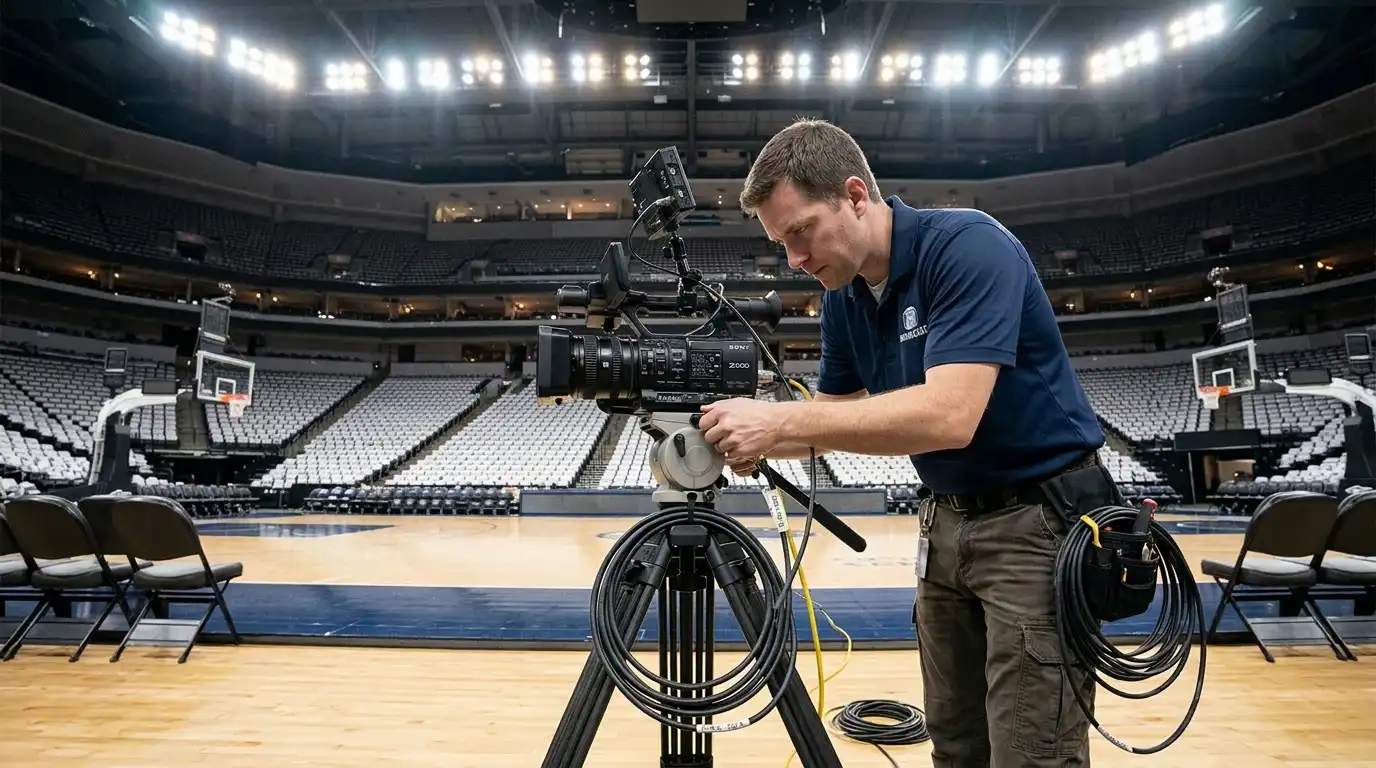
Loading access and vehicle routing
The production team arrives with equipment. That equipment must travel from vehicles to its installation positions. The route from the loading bay to the broadcast compound, and from the compound to each camera position, must be assessed in advance for: physical obstacles such as steps, narrow corridors, and low clearances that prevent equipment trolleys from passing; weight restrictions on floors and elevated platforms; competing traffic from other suppliers who will be building simultaneously; and time windows during which the loading bay is available.
For productions using an OB van or mobile production unit, vehicle access and parking must be confirmed before the build schedule is written. An OB van that cannot reach its operating position adds hours to the build through manual cable carrying over distances the vehicle would otherwise have bridged. The specific dimensions and weight of the vehicle must be communicated to the venue coordinator at the time of the venue survey, not on the day of arrival.
Build schedule and access windows
The build schedule must be coordinated with the event’s overall setup timeline. The broadcast team is one of several technical suppliers building simultaneously — audio, lighting, LED, staging, and hospitality may all be working in the same space. The build schedule must identify: the sequence in which broadcast equipment is installed, the access windows during which specific areas of the venue are available to the broadcast team, the points at which broadcast installation intersects with other suppliers’ work, and the named contact at the venue who can resolve access conflicts during the build.
A broadcast build that starts on time but loses four hours waiting for another supplier to clear a cable route has effectively started late. These intersections must be identified and sequenced in advance, not resolved reactively during the build.
Power connection and testing
Power for the broadcast installation must be connected, tested, and confirmed stable before camera and control room equipment is powered. This requires the venue’s electrical contractor to be on-site during the relevant window of the build, with the authority to resolve any issues with the power supply. A power fault discovered after broadcast equipment is installed and configured is far more disruptive than the same fault discovered during a pre-equipment power test.
The test must confirm not only that power is available at the required load but that it is clean — free from interference introduced by other venue systems sharing the circuit. The broadcast team’s technical director should conduct a signal test immediately after power connection, before full equipment setup proceeds.
Coordination with venue technical services
The broadcast production team requires active cooperation from three venue technical services during both the build and the live event: audio, lighting, and LED or video display systems. These are not passive dependencies — the quality of the broadcast signal is directly affected by how these systems operate.
Audio coordination
The broadcast team requires a programme audio feed from the venue’s front-of-house audio system. This feed must be agreed in advance: the type of connection, the signal level, the mix that will be provided, and the point in the venue audio signal chain from which it will be taken. A feed taken too early in the chain will not include key audio elements such as announcer microphones and music. A feed taken too late may include processing that degrades the broadcast signal.
The venue audio engineer and the broadcast audio engineer must meet during the build to confirm the connection and conduct a level test. This meeting should be scheduled — not assumed to happen organically during a busy setup day.
Lighting coordination
Camera exposure is set against the lighting conditions at the time of the camera line-up, which typically takes place one to two hours before the event. If the lighting state changes between the line-up and the broadcast — which it will, unless the lighting designer has been briefed — the cameras will be incorrectly exposed when the event begins. The broadcast team must provide the lighting designer with the lighting specification required for broadcast: colour temperature, minimum illuminance levels at the field of play, and any restrictions on the use of moving lights or strobe effects during live coverage.
For international events with federation lighting specifications — FIBA, CEV, and World Aquatics all publish minimum illuminance requirements for broadcast — these must be communicated to the venue lighting team as part of the event technical brief, not raised for the first time during the build.
LED and video display coordination
LED displays in modern sports venues create two challenges for broadcast. First, the refresh rate of some LED panels creates a visible flicker effect when captured on camera at standard broadcast frame rates — an effect that is not visible to the human eye in the venue but is clearly visible on the broadcast output. The LED system’s refresh rate must be confirmed compatible with the broadcast frame rate before the event. Second, the content displayed on LED systems appears in the broadcast picture and is subject to the same rights considerations as any other on-screen element. The broadcast team should be provided with the LED content schedule so that any rights conflicts can be identified and resolved before transmission.
Accreditation and crew access
Every member of the broadcast production crew requires accreditation that grants them access to their specific area of operation. Accreditation for international events is typically issued by the federation or the event organiser, not by the production company. This creates a dependency that must be managed proactively: the production partner must submit a complete crew list with the required access zones to the event’s accreditation manager by the deadline specified in the event technical brief.
Late accreditation submissions result in crew members who cannot access their positions on setup day. The consequences range from delayed builds to incomplete camera installations. For events with security screening at accreditation, the lead time for processing may extend the deadline further. The accreditation submission deadline must appear in the production timeline as a hard milestone with the production coordinator as its named owner.
Wrap: leaving the venue
The wrap — the process of breaking down and removing the broadcast installation after the event — requires the same level of coordination as the build, applied in reverse and under conditions of greater time pressure. The event venue typically needs to return to operational use within hours of the event ending, and the broadcast team is one of several suppliers competing for the same loading access simultaneously.
The wrap plan must specify: the sequence in which broadcast equipment is powered down and packed, the loading access windows available during the wrap, the route from each installation position back to the loading bay, and the final inspection and sign-off process that confirms the venue has been returned to its pre-event condition. Equipment that is damaged during a rushed wrap because the sequence was not planned costs money that a methodical wrap plan would have prevented.
For productions where archive material is being captured on physical media, the wrap plan must include a specific step for media handover — confirming that all recorded assets are accounted for, correctly labelled, and either transferred to the federation’s representative or secured in the production team’s custody before the compound is broken down.
Frequently asked questions
What is a broadcast build in sports event production?
The build is the phase of production between the team’s first arrival at the venue and the start of the live broadcast. It encompasses equipment delivery and installation, power connection and testing, camera positioning, control room setup, audio and lighting coordination with venue technical services, and the signal line-up that confirms all systems are functioning correctly before transmission begins.
How long does a broadcast build take for an international sports event?
Build duration depends on the complexity of the production and the access constraints of the venue. A four-camera production with a mobile control room in a venue that provides dedicated broadcast access typically requires six to eight hours. A larger production in a venue where broadcast build must be sequenced around other suppliers’ work may require one to two full days. The build duration should be estimated by the production partner based on the venue survey findings and factored into the event’s overall setup timeline.
Who is responsible for coordinating broadcast logistics with the event venue?
The broadcast manager, acting on behalf of the federation, is responsible for ensuring that the production partner’s logistical requirements are communicated to and accepted by the venue’s event operations team. The production partner is responsible for specifying those requirements accurately and in advance. The venue’s technical coordinator is responsible for confirming that the requirements can be met. All three must be in communication before the build schedule is finalised.
What should a broadcast wrap plan include?
The equipment power-down and packing sequence, loading access windows, the route from installation positions to the loading bay, media handover confirmation for all recorded assets, and a final venue inspection sign-off. The wrap plan should be prepared before the event and briefed to all production crew before the event ends, not improvised under the time pressure of a venue that needs to turn around.
Previous: Chapter 4: Venue assessment for international broadcast · Next: Chapter 6: Coordinating broadcast with venue AV, lighting and LED systems