
Sports Broadcast Management Guide · Chapter 3 of 14 · videoteamhungary.com
The most expensive mistakes in international sports broadcast happen before a single camera is ordered. They happen in the planning phase, when milestones are missed, decisions are deferred, and the production timeline is treated as something that can be compressed at the end.
Why timing is a structural problem, not a scheduling one
Broadcast production for international sports events involves a chain of interdependent decisions. The venue determines camera positions. Camera positions determine accreditation requirements. Accreditation requirements must be submitted to the venue by a fixed deadline. The transmission method determines whether satellite capacity must be booked weeks in advance. Graphics packages require approved federation branding. Commentary infrastructure requires confirmed rights holder attendance.
Each dependency has a lead time. When planning starts late, these lead times do not compress — they stack. The result is a production week where decisions that should have been made at six weeks are being made at six days, under conditions where every option costs more and every error has less room for correction.
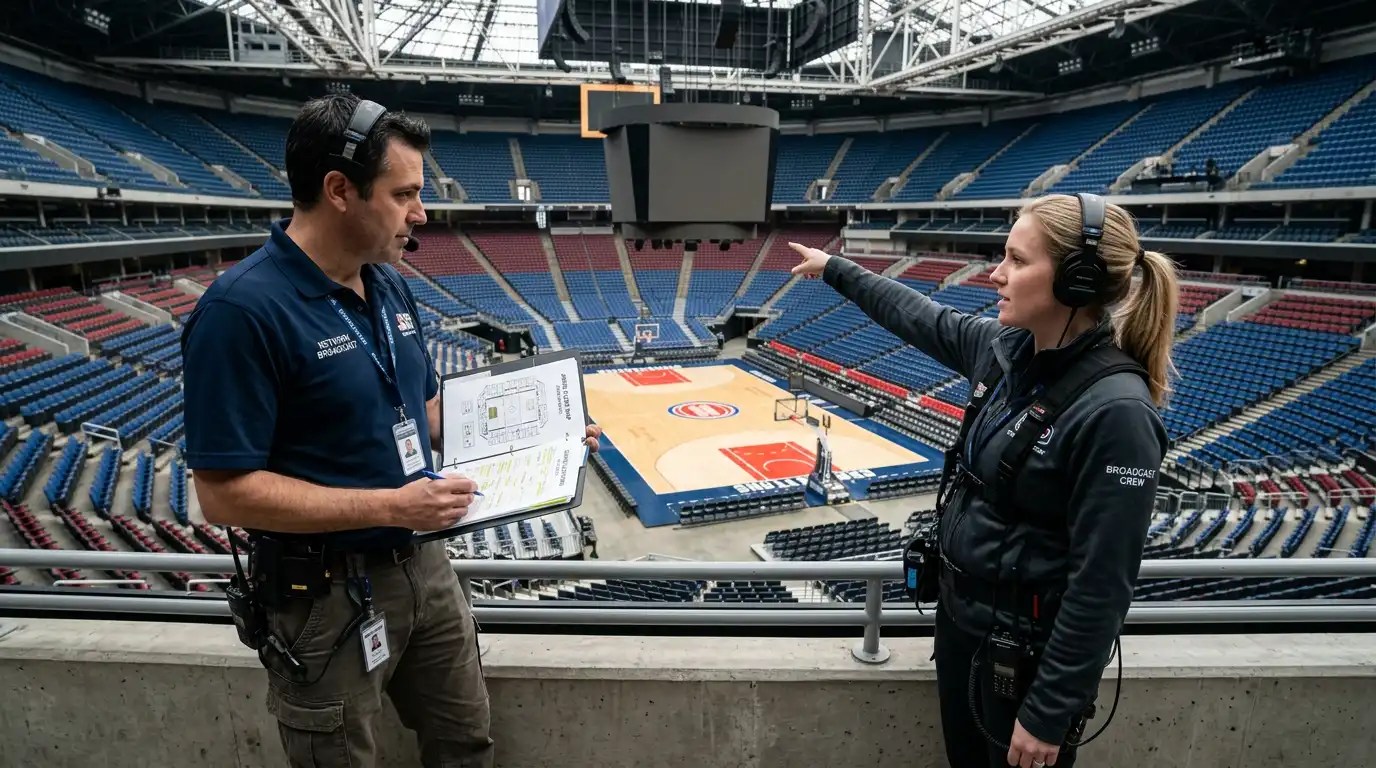
A broadcast production timeline is not a project management formality. It is the mechanism by which a federation controls the cost and quality of its broadcast output. Federations that start the timeline at tender stage are already behind.
The eight milestones of a broadcast production timeline
The following milestones apply to international sports events with at least one television rights holder. For events with multiple rights holders or satellite transmission requirements, each milestone moves earlier. For smaller domestic events, the milestones remain but the gap between them compresses.
Milestone 1: Broadcast scope definition — 12 to 16 weeks before event
The broadcast scope must be defined before any other production decision is made. This means identifying the primary output format, the rights holders who will receive a feed, and the contractual obligations already embedded in existing rights agreements. Without this, every downstream decision is provisional and subject to revision at increasing cost.
This is also the stage at which the broadcast manager should review the event’s existing technical rider from the venue, if one exists. Venue constraints on camera positions, power access, and connectivity will shape the production scope, and discovering them late creates conflict that is expensive to resolve.
Milestone 2: Broadcast mandate document finalized — 10 to 12 weeks before event
The broadcast mandate document must be complete before vendor tendering begins. It defines the minimum technical obligations, rights delivery requirements, and failure protocols that all production bids must be assessed against. A mandate that is written after tenders are received is not a mandate — it is a negotiation in which the federation starts from a position of weakness.
Milestone 3: Tender issued and production partner selected — 8 to 10 weeks before event
The tendering window for international sports broadcast production should allow a minimum of two weeks for bids to be prepared. Shorter windows reduce the quality of bids and signal to experienced production companies that the event is disorganized. The production partner should be confirmed and contracted no later than eight weeks before the event to allow adequate preparation time.
For events in Central Europe, the pool of production partners with genuine international broadcast experience is smaller than in Western European markets. This makes early tendering more important, not less — experienced companies book their technical resources and personnel well in advance, and late tenders are likely to encounter availability constraints.
Milestone 4: Venue technical survey — 6 to 8 weeks before event
The production partner must conduct a formal venue technical survey with the event’s technical director present. This survey confirms camera positions against the venue’s actual physical constraints, verifies power access points, assesses the connectivity infrastructure, and identifies any venue-specific factors that will affect the production plan. The survey output must be documented and distributed to all technical stakeholders.
Surveys conducted remotely, based on floor plans alone, are insufficient. Every venue presents conditions that plans do not capture — lighting, line-of-sight obstructions, power circuit locations, load restrictions. A survey that identifies a problem at six weeks leaves time to solve it. A survey that identifies the same problem at one week does not.
Milestone 5: Graphics package and branding approved — 4 to 6 weeks before event
On-screen graphics for international broadcast require approved federation branding: logos, colour specifications, font licences, and sponsor placement rules. The graphics package must also incorporate the specific requirements of television rights holders, who may have their own standards for lower-third typography, clock displays, and score presentations.
Graphics approval is the stage most commonly underestimated by federation communications teams who are simultaneously managing event marketing, accreditation, and operational logistics. Broadcast graphics are not a design task that can be resolved in a 24-hour turnaround. Build the approval cycle into the timeline with named approvers and fixed deadlines.
Milestone 6: Rights holder confirmation and commentary infrastructure briefing — 3 to 4 weeks before event
All rights holders who will attend the event in person must confirm their technical requirements no later than three weeks before the event. This includes the number of commentary positions required, unilateral camera requests, IFB and talkback configurations, and any special transmission arrangements. Late confirmations — which are common — must still fall within a window that allows the production team to accommodate them without structural changes to the plan.
Rights holders who confirm after this window should be accommodated where possible on a best-efforts basis, but the production team should not be required to restructure core infrastructure to do so. The confirmation deadline should be written into the rights holder technical information pack that is distributed at milestone three.
Milestone 7: Final production freeze — 3 to 5 days before event
No structural changes to the production plan should be accepted after this point. Structural changes include: modifications to camera positions, changes to the number of output feeds, alterations to the transmission path, and additions to the graphics package. Administrative changes — updated running orders, roster corrections, last-minute schedule adjustments — can continue to flow through the production coordinator up to and including event day.
The production freeze is not a preference — it is a quality control mechanism. Changes made in the final 72 hours before a live international broadcast create cascading risks that experienced production teams recognize and inexperienced ones discover too late.
Milestone 8: Post-event archive delivery — defined in the broadcast mandate
The delivery of archive assets after the event is a contractual obligation that should be defined in the broadcast mandate document, not agreed informally after the fact. The timeline should specify: the deadline for delivery of the production master, the format and naming conventions for all archived assets, the method of transfer to rights holders, and the contact responsible for confirming receipt and technical acceptance.
Post-event delivery is the milestone most commonly treated as an afterthought. For federations that intend to use archived footage for sponsorship reporting, future promotional content, or sublicensing, the quality and timeliness of the archive delivery has direct commercial value.
The timeline at a glance
| Milestone | When | Owner |
|---|---|---|
| 1 · Broadcast scope definition | 12–16 weeks before | Federation + broadcast manager |
| 2 · Mandate document finalized | 10–12 weeks before | Broadcast manager |
| 3 · Partner selected and contracted | 8–10 weeks before | Federation |
| 4 · Venue technical survey | 6–8 weeks before | Production partner |
| 5 · Graphics package approved | 4–6 weeks before | Federation comms + production |
| 6 · Rights holder confirmations | 3–4 weeks before | Federation broadcast manager |
| 7 · Production freeze | 3–5 days before | Production partner |
| 8 · Archive delivery | Per mandate | Production partner |
What happens when the timeline is not followed
The consequences of a compressed broadcast production timeline are predictable and consistent across event types and scales. Graphics arrive without approved branding and are rebuilt at cost. Rights holders submit technical requirements after the infrastructure is already specified and require last-minute modifications. The venue survey identifies a structural problem with a camera position that was assumed to be confirmed, forcing a redesign of the coverage plan. Satellite capacity is unavailable at the preferred transmission window because it was not booked in advance.
None of these are catastrophic individually. Collectively, in the final week before a live international broadcast, they consume the production team’s capacity for the careful preparation that prevents on-air failures. The timeline exists not because the milestones are bureaucratically necessary, but because each one removes a category of late-stage risk.
Frequently asked questions
How far in advance should a sports federation start planning broadcast production?
For international events with television rights holders, broadcast scope definition should begin 12 to 16 weeks before the event. For events with satellite transmission requirements, this window should extend further. The broadcast mandate document should be finalized at least ten weeks before the event, before vendor tendering begins.
What is a production freeze in broadcast?
A production freeze is a defined point — typically three to five days before a live event — after which no structural changes are accepted to the production plan. It covers camera positions, output feeds, transmission paths, and graphics packages. Administrative updates such as running orders and rosters continue to flow through normal channels. The freeze is a quality control mechanism, not a bureaucratic formality.
Why do sports federations in Central Europe need longer broadcast planning timelines?
The production partner pool with genuine international broadcast experience in Central Europe is smaller than in Western European markets. Experienced production companies book technical resources and crew well in advance. Late tenders encounter availability constraints that do not exist at full lead time. Starting early is not cautious — it is the condition for accessing the best partners and the best terms.
When should rights holders submit their technical requirements for an international sports event?
No later than three to four weeks before the event. Requirements submitted after this point cannot be guaranteed to be accommodated within the core production infrastructure. The confirmation deadline should be stated in the rights holder technical information pack distributed at the time the production partner is contracted.
What is the most common planning mistake in sports broadcast production?
Starting the broadcast planning process at the tendering stage rather than at the scope definition stage. The broadcast mandate document — which defines what must be delivered — should be complete before any vendor is contacted. When federations tender without a mandate, they receive bids that cannot be meaningfully compared, and the production that results is shaped by the vendor’s assumptions rather than the federation’s obligations.
Previous: Chapter 2: What a broadcast mandate document should contain · Next: Chapter 4: Venue assessment for international broadcast