
Sports Broadcast Management Guide · Chapter 7 of 14 · videoteamhungary.com
A broadcast production that cannot get its signal out of the venue has failed, regardless of the quality of what was produced inside it. Connectivity is the final technical dependency in the broadcast chain and the one most frequently underestimated at the planning stage. Venues that describe their internet as “fast” are not necessarily describing infrastructure that is suitable for broadcast transmission. The gap between what a venue has and what a broadcast production needs is often significant and always worth measuring in advance.
What broadcast transmission actually requires
Broadcast transmission requires a data connection with specific characteristics that are distinct from the characteristics relevant to everyday internet use. Download speed — the metric most venues use to describe their connectivity — is largely irrelevant. The relevant metrics are upload bandwidth, latency, jitter, and packet loss. A venue with fast download speed and inadequate upload capacity cannot support broadcast transmission, regardless of how its connectivity is marketed.
Upload bandwidth
Upload bandwidth determines the maximum quality at which a broadcast signal can be transmitted. A single HD 1080i/50 contribution feed at broadcast quality typically requires between 15 and 25 Mbps of sustained upload capacity. This capacity must be dedicated to the broadcast — not shared with venue operations, public WiFi, or other event systems. A connection that delivers 25 Mbps to a speed test but shares that capacity with a venue’s office network will not reliably deliver 25 Mbps to a broadcast encoder during a live event.
Events with multiple simultaneous output feeds — for example, a domestic broadcast feed and a clean international feed, or parallel streams to multiple rights holders — require proportionally more upload capacity. The total required upload bandwidth should be calculated from the broadcast mandate document and specified to the venue as a minimum dedicated requirement, not a preference.
Latency and jitter
Latency is the time it takes for a data packet to travel from the broadcast encoder to the receiving facility. For contribution feeds delivered to a broadcaster or streaming platform, high latency introduces delay into the distribution chain. For live events with tight editorial requirements — commentary synchronisation, scoreboard integration, replay timing — latency affects the precision with which on-air elements can be coordinated.
Jitter is the variation in latency over time. A connection with consistent 20ms latency is more reliable for broadcast than one with latency that varies between 5ms and 80ms. Jitter introduces unpredictability into the transmission that broadcast protocols must compensate for through buffering — and excessive jitter causes buffering that degrades the broadcast or interrupts transmission entirely.
Packet loss
Packet loss is the proportion of data packets that fail to reach their destination. For broadcast transmission, any packet loss above 0.1 percent at the bandwidth levels required for HD video creates visible artefacts or interruptions in the broadcast output. The connection used for broadcast must be tested for packet loss under load conditions that approximate the live event — not tested at a time when the venue is empty and no other systems are competing for bandwidth.
Connection types and their broadcast suitability
Dedicated fibre contribution
A dedicated fibre contribution circuit — a point-to-point connection from the venue to a broadcast facility or interchange point — is the most reliable connectivity solution for international sports broadcast. It provides guaranteed bandwidth, consistent latency, and no traffic sharing. For regular broadcast venues such as national arenas and purpose-built sports facilities, a permanent contribution circuit is standard infrastructure. For temporary venues or facilities that do not regularly host broadcast events, a temporary contribution circuit must be ordered from a telecommunications provider with sufficient lead time — typically four to six weeks minimum.
Broadband internet with SRT or other resilience protocols
For events where a dedicated fibre circuit is not available or not cost-justified, broadcast-quality transmission over standard broadband internet is achievable using protocols designed for resilience over variable networks. SRT (Secure Reliable Transport) is the most widely used protocol for this purpose in international sports broadcast. It implements packet retransmission, forward error correction, and latency management to compensate for the variability of public internet connections.
SRT transmission requires a broadband connection with adequate upload capacity and, critically, a network configuration that does not block the ports and protocols SRT uses. Venue networks with aggressive firewall rules, port filtering, or traffic shaping that deprioritises real-time data streams are a common source of transmission failures. The broadcast team must test the specific connection — including any firewall configuration — before the event, not assume that a connection described as unrestricted actually is.
Bonded cellular as backup or primary
Bonded cellular transmission — combining the bandwidth of multiple mobile data connections — is used both as a backup path for primary broadcast transmission and, for smaller events, as the primary connection. It is a genuinely viable option for events at venues without fixed broadband infrastructure, provided the cellular coverage at the specific venue location is adequate and not subject to congestion from event attendance.
The reliability risk with cellular transmission is venue-specific. A venue in a dense urban area with strong multi-operator coverage may support bonded cellular reliably. The same approach at a rural venue or an indoor venue with poor cellular penetration will not. Cellular coverage must be tested at the specific broadcast compound location, not assumed from the general area’s coverage maps. During large events, spectator device activity can saturate local cells and degrade the cellular connection regardless of pre-event test results.
WiFi and shared broadband — not suitable for broadcast
Shared WiFi and shared broadband connections — connections used simultaneously by venue staff, event operations, and any other users — are not suitable as the primary connection for broadcast transmission. The bandwidth available to the broadcast encoder on a shared connection is unpredictable and will vary during the event as other users increase their activity. WiFi adds radio frequency interference and connection instability that a wired connection does not have. These are not configurations that can be made to work reliably for broadcast through careful management. They are simply not the right tool for the task.
Testing the connection before the event
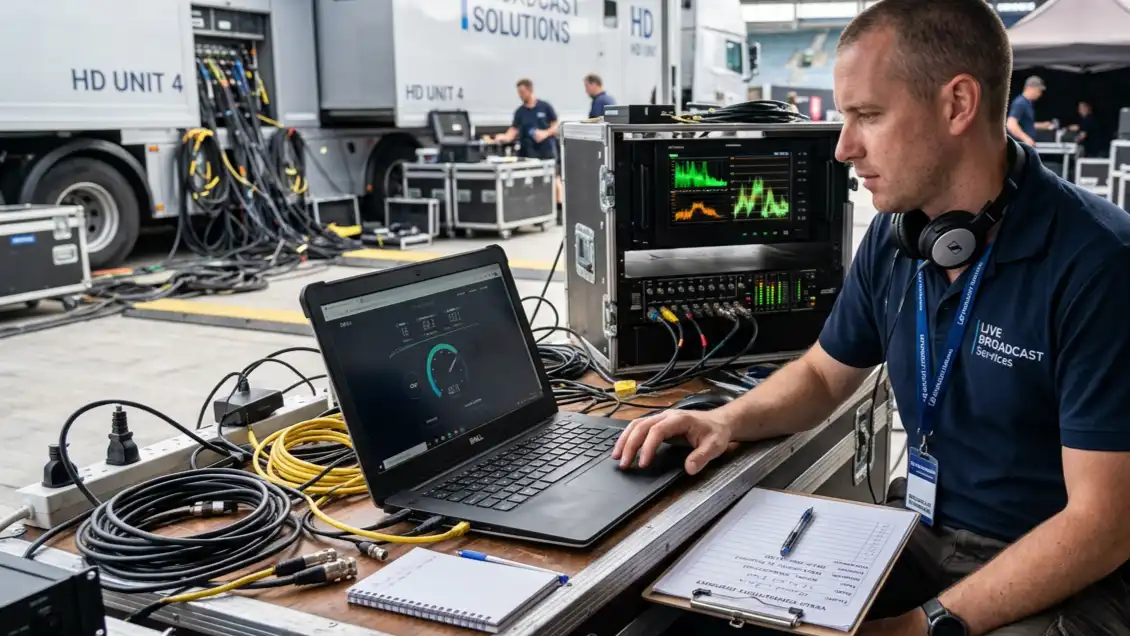
The broadcast connection must be tested at the venue survey, not assumed on the basis of the venue’s description of its infrastructure. The test must be conducted from the broadcast compound location using the specific connection that will be used for the event, with all other venue systems operating normally. A test conducted in an empty venue at a different location from the compound is not a meaningful test of broadcast suitability.
The test should measure upload bandwidth at sustained load, latency and jitter under load conditions, packet loss at the bandwidth levels the broadcast will require, and the specific port and protocol availability needed by the transmission system. Where possible, a test transmission using the actual broadcast equipment and transmission platform should be conducted during the venue survey to confirm end-to-end functionality.
Frequently asked questions
What internet speed is needed for live sports broadcast?
A single HD 1080i/50 broadcast contribution feed requires a minimum of 15 to 25 Mbps of dedicated upload bandwidth. This must be a dedicated connection, not shared with other venue systems. Events transmitting multiple simultaneous feeds require proportionally more. The relevant metric is upload speed on a dedicated connection, not the total bandwidth of the venue’s internet contract.
What is SRT in broadcast?
SRT stands for Secure Reliable Transport. It is an open-source protocol developed for reliable video transmission over unpredictable network conditions, such as public internet connections. It uses packet retransmission and forward error correction to recover from packet loss, and manages latency to compensate for jitter. It is widely used for contribution feeds in international sports broadcast when dedicated fibre circuits are not available.
Can a sports event be broadcast or livestreamed over WiFi?
Not reliably as the primary broadcast connection. WiFi introduces radio frequency variability, bandwidth sharing with other users, and connection instability that is incompatible with the sustained, consistent throughput that broadcast transmission requires. A dedicated wired connection — fibre, ethernet to a dedicated broadband circuit, or bonded cellular as a fallback — is the minimum standard for reliable broadcast transmission.
What should be tested at a venue before a broadcast event?
Upload bandwidth at sustained load from the broadcast compound location, latency and jitter under load conditions, packet loss at the bandwidth levels required by the broadcast, port and protocol availability for the specific transmission system being used, and where possible an end-to-end test transmission using the actual broadcast equipment. The test must be conducted under conditions that replicate the live event environment, not in an empty venue at a time when no other systems are active.
Previous: Chapter 6: Coordinating broadcast with venue AV, lighting and LED systems · Next: Chapter 8: Feed architecture — designing what the viewer sees