
Sports Broadcast Management Guide · Chapter 14 of 14 · videoteamhungary.com
The broadcast ends. The live window closes. And in most federations, that is where the broadcast value stops — because nothing was planned for what comes after. The production master sits on a hard drive. The ISO recordings are never edited. The highlights that would have driven traffic to the federation’s channels, supported sponsor reporting, and built the audience for next year’s event are never produced. Not because there was no material. Because there was no plan.
Post-event content value is not a bonus for federations with large budgets and dedicated content teams. It is the second half of the broadcast investment — and it begins with the decisions made before the production starts, not after it ends.
Why post-event value starts at the planning stage
Every post-event content decision depends on what was captured during the production. A federation that wants to produce a highlights package from an event where no ISO recordings were made has one source: the director’s mixed output. It can cut between camera selections the director made in real time, but it cannot go back to the wide shot the director did not use at the moment of the winning goal, or the athlete close-up that was on camera 3 while camera 1 was on the scoreboard.
ISO recordings, clean feed recordings, and high-quality production masters are not archive decisions. They are post-production decisions that must be made before the production begins. The broadcast mandate is the place where this planning happens — and a mandate that does not specify post-event content deliverables is a mandate that has not considered the full value of the broadcast investment.
The primary post-event content formats
The event highlights package
A structured highlights package — typically three to twelve minutes for a sports event — is the most versatile post-event content asset. It can be distributed to rights holders who did not broadcast the live event, embedded on the federation’s website, shared across social media platforms, and used in sponsorship reports to demonstrate the broadcast reach and production quality of the event.
The highlights package should be specified in the broadcast mandate before the event: duration, format for each distribution platform, the deadline for delivery after the event ends, and the approval process for content. A highlights package delivered six weeks after the event has limited promotional value for the next event on the federation’s calendar. One delivered within 48 to 72 hours of the event ending can still ride the event’s audience momentum.
Social media cutdowns
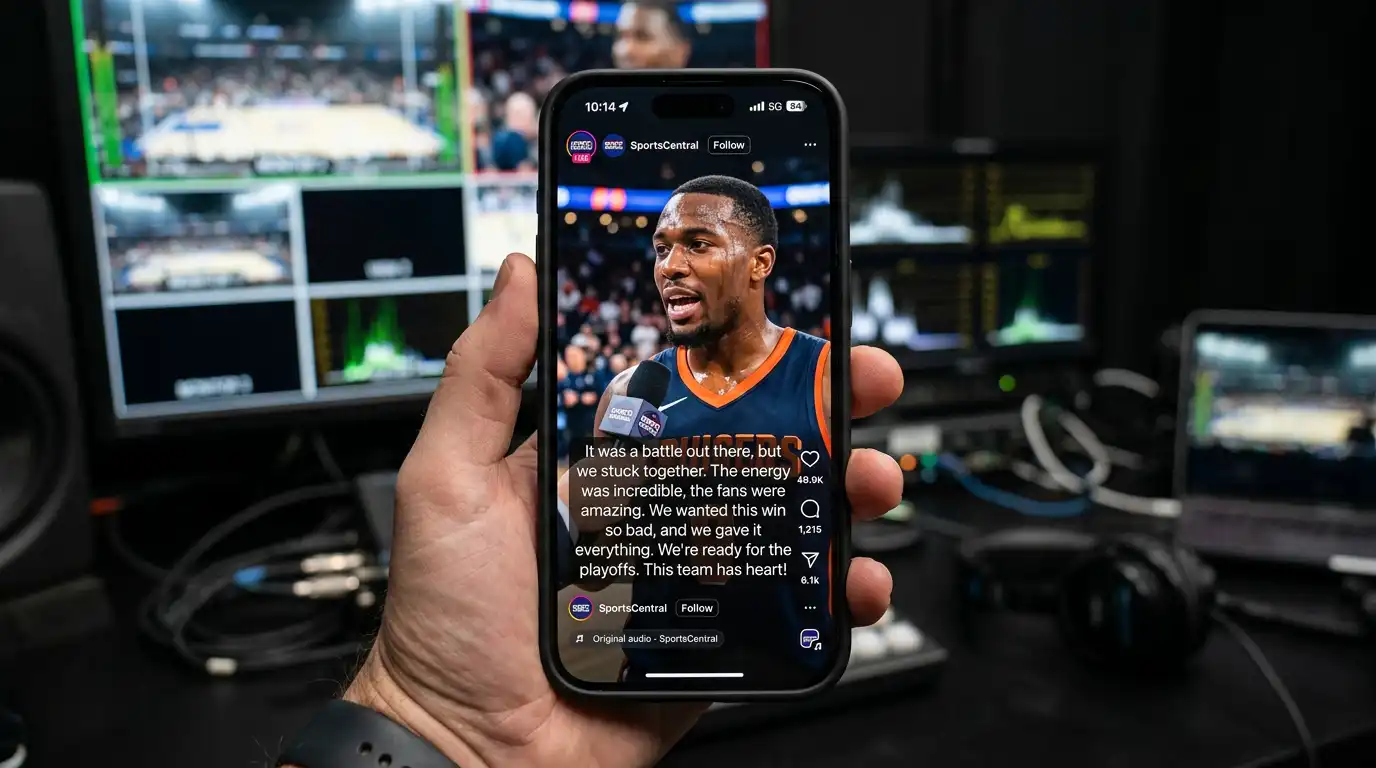
Social media cutdowns — short clips of 30 to 90 seconds extracted from the broadcast — serve a different function from the highlights package. They are designed for platform-native consumption: vertical format for Instagram Reels and TikTok, square format for feed posts, horizontal for YouTube Shorts and Twitter. They drive traffic back to the federation’s owned channels, build ongoing audience awareness between events, and provide the federation with branded content assets that can be used for promotion of future events.
The most effective social cutdowns are produced from moments that were captured in the broadcast but not necessarily featured prominently in the live mix: athlete reaction shots, crowd moments, the second before and after the decisive moment. These require ISO recordings. A production that delivered a technically excellent broadcast from three cameras with no ISO recordings gives the content team one source — the programme mix — and limited ability to produce the close, human moments that perform best on social platforms.
Archive broadcast for VOD distribution
The full broadcast recording, made available as video-on-demand after the live window, continues to accumulate viewing time for months and years after the event. Sports content has longer VOD longevity than almost any other content category — championship footage from several years ago continues to be watched by fans following athletes, by media covering anniversary stories, and by potential new fans discovering the sport.
VOD distribution requires a clean programme master — the broadcast without any time-limited sponsor integrations that have expired, without any music rights that do not extend to archive distribution, and in a format appropriate for the VOD platform. These are not complications that can be resolved after the event if they were not planned for in advance. Music rights in particular are a common source of post-event distribution problems: a track that was cleared for live broadcast may not be cleared for archive distribution, and the only remediation is to remove or replace the music — which requires an editable file at sufficient quality to re-render the output.
Rights holder sublicensing packages
Edited sublicensing packages — formatted clips or highlight reels produced to the technical specifications of a specific broadcaster or platform — allow federations to extend the commercial reach of their broadcast into markets or platforms that did not hold live rights. A federation that produces a clean, well-edited highlights package to EBU specifications can offer it to European broadcasters as a news or magazine item. A federation that produces only a raw programme master cannot make this offer without additional production investment.
The sponsor reporting value of broadcast content
Broadcast content is a sponsor reporting asset. A sponsor whose logo appeared in the broadcast’s lower-third graphics, on the venue’s LED displays, or in the ceremony backdrop has a legitimate interest in documentation: how many viewers saw the broadcast, for how long, and with what frequency the sponsorship placement appeared on screen.
This documentation requires two things: the viewing data discussed in Chapter 13, and the broadcast recording with the sponsor placements intact. A federation that can provide a sponsor with a viewing report showing 50,000 hours of total viewing time across 12,000 unique viewers, alongside a highlights clip that demonstrates the sponsor’s integration, has delivered a professional sponsorship report. A federation that can only report a view count has delivered a number that sponsors are increasingly treating as inadequate evidence of value.
A post-event content calendar
Post-event content does not produce itself. It requires a plan — a production schedule that specifies what will be produced, by whom, for which platforms, and by when. This plan should be written before the event, not improvised in the days after it. The broadcast mandate should include a post-event content schedule as an appendix or a linked document, so that the production partner understands what material needs to be captured and the content team understands what they will have to work with.
| Asset | Timeline after event | Primary use |
|---|---|---|
| Social cutdowns (2-3 clips) | Within 24 hours | Social media, audience momentum |
| Highlights package (3-12 min) | 48-72 hours | Rights holders, website, sponsor reporting |
| Full broadcast VOD | 48-72 hours | Owned channels, archive |
| Production master delivery | Per mandate deadline | Federation archive, future production |
| ISO recordings delivery | Per mandate deadline | Future content production |
| Sponsor viewing report | Within 30 days | Sponsor retention, renewal |
Frequently asked questions
How soon after a sports event should highlights be published?
Within 48 to 72 hours for a structured highlights package. Social media cutdowns should ideally be published within 24 hours — or, for the most significant moments, within hours of the event ending. Audience interest in sports content peaks during and immediately after the event and declines rapidly over the following days. Content published a week after the event reaches a fraction of the audience that the same content would have reached in the first 48 hours.
Can a federation produce post-event content without ISO recordings?
Yes, but with significant limitations. The programme mix provides the director’s selection of camera cuts — which is a complete broadcast record but a constrained source for post-production editing. Without ISO recordings, the content team cannot access angles that were not selected in the live mix, cannot produce athlete-specific coverage packages, and is limited to re-cutting existing transitions rather than creating new edit points. For federations with active post-event content programmes, ISO recordings are a production requirement, not an optional extra.
What is the VOD longevity of sports broadcast content?
Sports championship and competition content typically has one of the longest VOD lifespans of any content category. Footage from European and World Championships remains actively searched and watched for years after the event — by fans following athlete careers, by media covering sport anniversaries, by new audiences discovering a sport. A well-produced event broadcast that remains available as VOD continues to accumulate viewing time and audience relationships long after the live broadcast window has closed. This long-tail value is part of the total broadcast investment return that federations systematically undercount when they measure only live viewing.
Previous: Chapter 13: Measuring broadcast performance — KPIs for sports rights holders
This is the final chapter of the Sports Broadcast Management Guide. Return to the guide contents or get in touch to discuss broadcast planning for your next event.