
Sports Broadcast Management Guide · Chapter 6 of 14 · videoteamhungary.com
The broadcast picture is shaped by everything in front of the cameras. Lighting, LED displays, and the audio environment are not independent of the broadcast production — they are inputs to it. When these systems are specified, installed, and operated without reference to the broadcast, the result is visible on air: incorrectly exposed images, LED flicker across the frame, acoustic interference on commentary, and a production that is technically competent but visually compromised.
Coordination between broadcast and venue technical services is not a courtesy. It is a technical requirement that must be built into the event planning process from the start.
Audio coordination
What the broadcast team needs from venue audio
The broadcast team requires a programme audio feed from the venue’s front-of-house mixing console. This feed must deliver the full programme mix — including announcer microphones, crowd atmosphere, and any music or sound effects played during the event — at a stable, agreed signal level, with minimal latency and without the processing artefacts that some venue audio chains introduce.
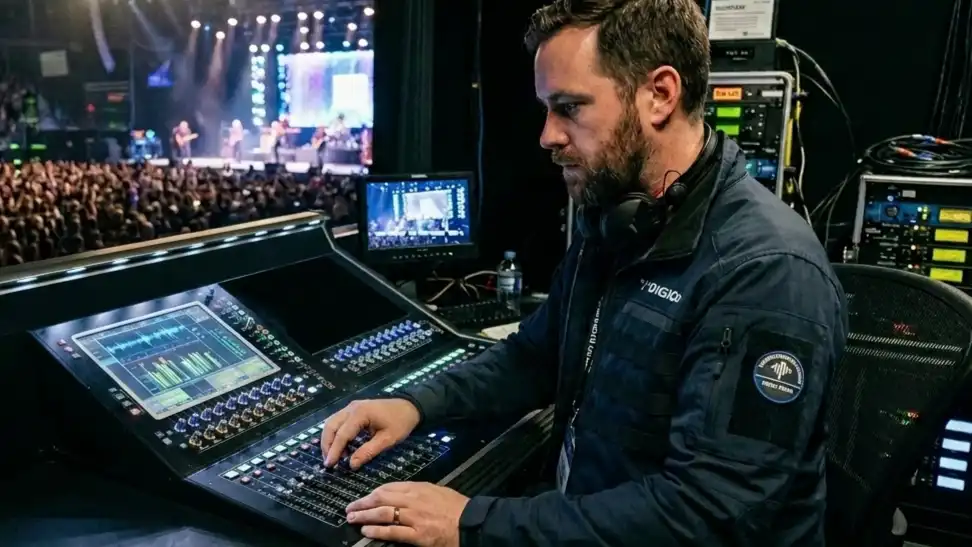
The connection method and the point in the signal chain from which the feed is taken must be agreed in advance. A direct output from the FOH console, pre-master bus processing, is generally preferred for broadcast because it gives the broadcast audio engineer control over the final mix. A post-processing feed introduces the venue’s EQ, compression, and limiting decisions into the broadcast signal — which may be appropriate for venue acoustics but is not necessarily appropriate for a broadcast mix that will be heard through domestic speakers and headphones.
The international sound feed
Events with multiple rights holders distributing content to broadcasters in different language markets require an international sound feed — a programme audio mix that contains venue atmosphere, sport-specific sounds, and announcer content but no commentary. This feed allows each rights holder to add their own language commentary over a consistent international audio bed.
Producing the international sound feed is the broadcast team’s responsibility, but it depends on receiving adequate venue audio inputs. The venue audio engineer must be briefed on the requirement so that the inputs the broadcast team needs — crowd microphones, pitch-side effects, timing systems — are available and routed appropriately.
Commentary position audio
Commentary positions require an IFB feed — interrupted foldback, a direct audio return to the commentator’s earpiece — and a programme feed. Commentary positions adjacent to public address loudspeakers are acoustically unusable without mitigation, because the PA bleed into open commentator microphones creates audio interference on the broadcast output. This is not resolvable during the event. Commentary positions must be physically located away from direct PA coverage during the venue survey, with acoustic treatment applied where necessary.
Lighting coordination
Why broadcast lighting is different from venue lighting
Camera exposure is determined by the light at the time of the camera line-up, which takes place before the event. If the lighting state during the event differs from the state during the line-up — which it will, unless the lighting designer has been specifically briefed — the cameras will be incorrectly exposed when the broadcast begins.
The broadcast team’s primary requirements from venue lighting are: consistent illuminance levels across the field of play, a colour temperature that is stable and within the range the cameras are calibrated for, and no dynamic lighting effects — moving lights, colour changes, strobes — on the field of play during live coverage. Effects lighting designed for spectator experience is incompatible with broadcast if it changes the exposure or colour balance of the primary broadcast picture.
Federation lighting standards for broadcast
Major international sports federations publish minimum illuminance requirements for broadcast. FIBA requires a minimum of 1400 lux at floor level for televised basketball. CEV specifies minimum illuminance levels for volleyball dependent on the broadcast category of the event. World Aquatics publishes lighting specifications for competition pools that include broadcast-specific requirements for colour rendering index and uniformity.
These standards exist because broadcast cameras require a minimum light level to produce a clean image without excessive noise, and because the uniformity of lighting across the field of play affects the consistency of the broadcast picture as cameras cut between angles. Venues that meet the spectator experience requirements for their standard events may not meet federation broadcast requirements without additional fixtures or reconfiguration. This must be established at the venue survey stage, not discovered during the build.
The lighting brief to the venue
The broadcast manager should provide the venue’s lighting designer with a written brief that specifies: the required illuminance levels at the field of play, the colour temperature range, the freeze state that must be in place during the camera line-up and maintained throughout the broadcast, and the restrictions on dynamic effects during live coverage. This brief should be provided as part of the event technical documentation distributed to all venue technical services, not communicated verbally during the build.
LED and video display coordination
The refresh rate problem
LED panels operate at a refresh rate that determines how many times per second the image on the panel is redrawn. When the panel’s refresh rate is not synchronised with the broadcast camera’s frame rate, the camera captures different phases of the LED refresh cycle across consecutive frames, creating a visible flicker effect in the broadcast picture. This effect is not visible to the human eye in the venue — it only appears in the broadcast output.
The LED system’s refresh rate must be confirmed compatible with the broadcast frame rate before the event. For HD broadcast at 50 fields per second — the standard for European sports broadcast — the LED system must operate at a refresh rate that is a multiple of 50Hz. Most modern sports venue LED systems can be configured to meet this requirement, but the configuration must be requested and verified, not assumed.
LED content and broadcast rights
Content displayed on LED systems during the broadcast is captured in the broadcast picture and is subject to rights considerations. Music-licensed content, sponsor graphics with territorial restrictions, and third-party footage all appear in the broadcast output and may create rights conflicts for rights holders distributing the broadcast in markets where the content is not cleared.
The broadcast team should receive the LED content schedule in advance so that any rights conflicts can be identified. For events where the broadcast is being distributed internationally, the LED content should be reviewed against the territorial restrictions applicable to each rights holder’s broadcast territory. This is a rights management task that belongs to the federation’s commercial or legal function, but it requires the broadcast team’s involvement to identify which content is captured in the broadcast picture.
Scoreboard and results systems
Venue scoreboards and results display systems are broadcast assets. A scoreboard that is readable from the main camera position removes the need for a dedicated broadcast graphics overlay for score information — or at minimum provides the data that drives the broadcast graphics. The broadcast team should confirm, during the venue survey, whether the venue’s scoring system can provide a data feed to the broadcast graphics system, and whether the scoreboard is positioned to be legible from the main broadcast camera angle.
The coordination meeting
Coordination between broadcast and venue technical services should not rely on informal communication during the build. A structured technical coordination meeting should take place during the build day, attended by the broadcast technical director, the venue audio engineer, the venue lighting designer, and the LED system operator. The meeting agenda should cover: the audio connection and level test, the lighting freeze state confirmation and line-up schedule, the LED refresh rate configuration, and any outstanding technical issues identified at the venue survey.
This meeting should be scheduled in the build timeline as a fixed event, not treated as something that will happen organically when the relevant people are available. In a busy multi-supplier build, the relevant people are rarely available at the same time without a scheduled commitment.
Frequently asked questions
Why does LED lighting flicker on broadcast cameras?
LED panels refresh at a rate that may not be synchronised with the broadcast camera’s frame rate. When the panel refresh rate and the camera frame rate are not matched, the camera captures different phases of the LED cycle across frames, creating visible flicker in the broadcast output. The solution is to configure the LED system to operate at a refresh rate that is a multiple of the broadcast frame rate — typically a multiple of 50Hz for European broadcast.
What illuminance level does a venue need for international sports broadcast?
It depends on the sport and the broadcasting federation’s standards. FIBA requires a minimum of 1400 lux at floor level for televised basketball. CEV and World Aquatics publish their own specifications. As a general baseline, broadcast cameras at HD resolution typically require a minimum of 1000 lux at the field of play to produce a clean image without noise at standard ISO settings. Events with fast motion — athletics, swimming, combat sports — benefit from higher illuminance levels that allow faster shutter speeds and reduced motion blur.
What is an IFB in broadcast?
IFB stands for interrupted foldback. It is the audio return feed to a commentator’s or presenter’s earpiece that allows the production director or producer to communicate with on-air talent during a live broadcast. At commentary positions, the IFB typically carries the programme audio feed — so the commentator can hear the broadcast output — with the ability to interrupt it with production talkback when needed. It is a standard requirement at every commentary position for international sports broadcast.
Who is responsible for ensuring venue lighting meets broadcast standards?
The federation or event organiser is responsible for ensuring that the venue meets the broadcast technical requirements specified in the broadcast mandate. In practice, this means the broadcast manager must communicate the lighting requirements to the venue during the planning phase, verify compliance at the venue survey, and escalate any shortfall to the event director in time for remediation. The venue’s lighting team is responsible for implementing the requirements, but they cannot implement requirements they have not been given.
Previous: Chapter 5: Production logistics for international sports broadcast · Next: Chapter 7: Connectivity requirements for international sports broadcast