
Sports Broadcast Management Guide · Chapter 4 of 14 · videoteamhungary.com
A venue that looks adequate on a floor plan can present conditions that fundamentally change the production plan on the day of the survey. Camera positions that appeared straightforward become obstructed. Power access points that were assumed to be available are on separate circuits with insufficient load capacity. Connectivity infrastructure that was described as suitable turns out to require engineering work that cannot be completed before the event.
These are not rare exceptions. They are the standard findings of a properly conducted venue technical survey. The survey is not a formality — it is the mechanism by which the production plan is validated against physical reality.
What a venue assessment covers
A venue assessment for international sports broadcast is not a walkthrough. It is a structured technical inspection conducted by the production partner and the event’s technical coordinator, with outputs that are documented, distributed, and acted upon before the event. It covers six areas.
1. Camera positions and sightlines
Every camera position specified in the broadcast mandate must be physically verified against the venue’s actual layout. The verification must confirm that the position delivers the required sightline without obstruction, that the position can be occupied without creating safety or operational conflicts with other event functions, that the position has access to the required power supply within cable run distance, and that the position can be reached by the production crew with their equipment.
For sports with federation-mandated camera positions — FIBA for basketball, CEV for volleyball, World Aquatics for swimming — the survey must confirm compliance against the federation’s technical appendix, not against a general production preference. Deviations from mandated positions must be documented and submitted to the relevant federation for approval before the event.
2. Power infrastructure
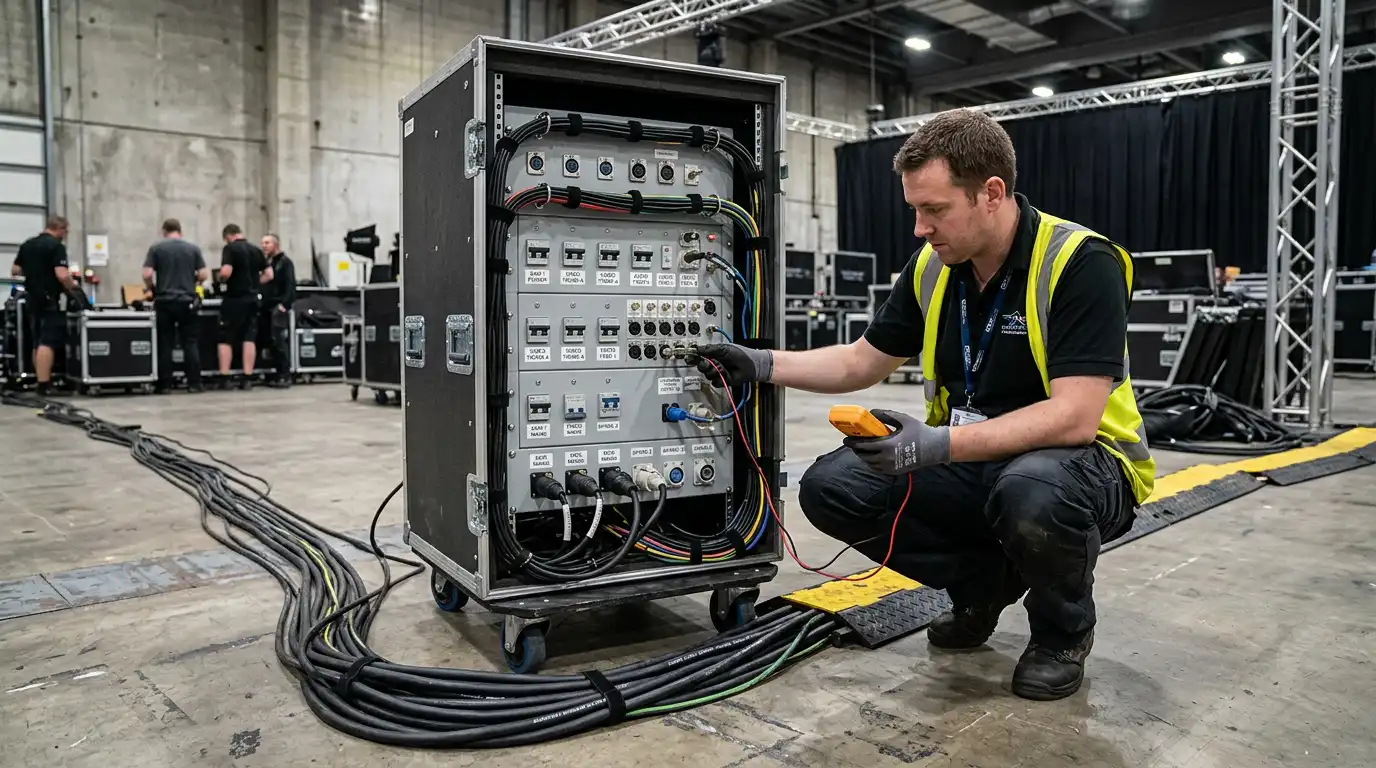
Broadcast production equipment draws significant power. A multi-camera production with a mobile control room, monitoring systems, and transmission equipment can require dedicated circuits with capacity that most sports venues do not provide as standard. The survey must identify: available power sources at or near each camera position, the total load capacity of available circuits, the distance and routing of cable runs from power sources to equipment positions, and the availability of a dedicated broadcast power feed that is not shared with venue lighting, audio, or LED systems.
Shared power circuits are a common source of broadcast interference. When a venue’s lighting system is on the same circuit as the broadcast feed, switching events — dimming, scene changes, spotlight cues — introduce noise into the broadcast signal. This is not a technical problem that can be solved during production week. It must be identified at the survey stage and resolved by the venue’s electrical contractor in advance.
3. Connectivity and internet infrastructure
Internet connectivity for broadcast transmission has specific requirements that consumer or corporate internet connections do not meet. The survey must assess: the available upload bandwidth on a dedicated connection not shared with venue operations or public access, whether the connection supports the specific port and protocol configuration required by the transmission platform, the physical routing of the connection from the ISP entry point to the broadcast compound, and the availability of a secondary or backup connection path.
Venues that describe their connectivity as “high speed” or “fibre” are not necessarily describing a connection that is suitable for broadcast transmission. Upload capacity is the relevant metric, not download speed. A venue with 1 Gbps symmetric fibre to its main office and a 20 Mbps asymmetric consumer connection to its event floor has a connectivity problem for broadcast, regardless of how its facilities are marketed.
4. Broadcast compound and control room positioning
The broadcast compound — the area where the production control room, transmission equipment, and crew operations are based — requires a defined footprint, power supply, and cable access routes to all camera positions. The survey must identify a compound location that meets these requirements, is accessible to production vehicles for equipment delivery and setup, and does not create operational conflicts with other event functions such as athlete access, spectator circulation, or emergency routes.
For events using a mobile production unit or OB van, the survey must also assess vehicle access and parking for a vehicle of the specific dimensions involved. An OB van that cannot reach its intended operating position because of a low barrier, a weight-restricted surface, or a turning radius constraint is a problem that must be identified at the survey, not on setup day.
5. Commentary and unilateral positions
Commentary positions for rights-holding broadcasters must be physically inspected to confirm: the sightline to the field of play, the acoustic environment (commentary positions adjacent to public address speakers are unusable without mitigation), the available connectivity for IFB, programme feed, and talkback, and the physical space for the number of commentators and the equipment they will bring.
Unilateral positions — dedicated areas for broadcasters operating their own cameras — require the same inspection criteria as main camera positions, with the addition of confirming that the position can be allocated to a specific broadcaster without creating conflicts with other rights holders’ positions or with spectator access.
6. Accreditation and access logistics
Every member of the production crew, and every broadcaster operating a unilateral position, requires accreditation that grants physical access to their designated area of operation. The survey must identify: the accreditation process and its lead time, the specific access zones that broadcast crew will require, any restrictions on equipment that can be carried into specific zones, and the security procedures that will apply during setup, the event, and breakdown.
Accreditation that arrives on the day of setup, or that grants incorrect access zones, is one of the most common causes of production delays. The survey should establish a named venue contact who is responsible for accreditation delivery, and the timeline for delivery should be written into the production schedule.
The survey output document
A venue technical survey that is not documented is not a survey — it is a walkthrough. The survey output must be a written document that includes: confirmed and rejected camera positions with the reason for each rejection and the proposed alternative, power availability and load capacity at each position, connectivity assessment with upload test results, compound footprint and vehicle access confirmation, commentary and unilateral position specifications, accreditation requirements and the delivery timeline, and a list of outstanding items that require resolution before the event, with a named owner and deadline for each.
This document should be distributed to the federation’s event director, the broadcast manager, the production partner’s technical director, and the venue’s technical coordinator within five working days of the survey. Outstanding items must be tracked through to resolution.
When surveys are conducted too late
The practical consequence of a late venue survey is that problems which are solvable at six weeks become unsolvable at two weeks. Power infrastructure modifications require an electrician, an engineer’s sign-off, and typically a venue shutdown window that cannot be created in the week before an event. Connectivity upgrades require an ISP installation visit with a lead time that regularly exceeds two weeks. Camera position alternatives that require structural modifications — rigging, platform construction, barrier repositioning — require permissions, contractors, and time.
A production team that discovers these problems during setup week adapts by compromising. Camera positions are moved to suboptimal locations. Broadcast crews operate on shared power with the interference risks that entails. Connectivity is supplemented with mobile data — which introduces latency, compression artefacts, and reliability risks that a fixed connection does not. The broadcast that results is technically inferior to what was planned, and the production team has managed the gap rather than prevented it.
Frequently asked questions
What is a venue technical survey for sports broadcast?
A structured technical inspection of the event venue conducted by the production partner and the event’s technical coordinator. It verifies camera positions, power infrastructure, connectivity, broadcast compound positioning, commentary positions, and accreditation logistics against the specific requirements of the broadcast mandate. The output is a written document with confirmed positions, outstanding issues, and a named resolution timeline.
How far in advance should a venue technical survey be conducted?
Six to eight weeks before the event. This window allows sufficient time to resolve infrastructure issues — power modifications, connectivity upgrades, structural changes — that typically require contractor engagement with lead times of two to four weeks. Surveys conducted inside four weeks before the event frequently identify problems that cannot be resolved in time.
What upload speed does a venue need for international sports broadcast?
The required upload capacity depends on the output format and the number of simultaneous feeds being transmitted. A single 1080i/50 contribution feed at broadcast quality typically requires a minimum of 15 to 20 Mbps dedicated upload on a connection with low latency and no traffic sharing. Events with multiple simultaneous feeds — for example, a domestic broadcast feed and a clean international feed — require proportionally more capacity. The specific requirement should be documented in the broadcast mandate and tested at the venue survey.
Can a venue floor plan replace a physical survey?
No. Floor plans do not capture lighting conditions, acoustic environments, power circuit routing, load restrictions, physical obstructions at sightline level, or the operational reality of how a venue functions during an event. Every physical survey conducted against a floor plan produces findings that the plan did not predict. The survey is not a verification of the floor plan — it is an independent assessment of the venue’s actual broadcast suitability.
Who should conduct the venue technical survey?
The production partner’s technical director, accompanied by the federation’s broadcast manager or event technical coordinator. The venue’s technical manager should also attend to provide direct answers on power capacity, connectivity infrastructure, and access logistics. A survey conducted without a venue representative present will produce a list of questions rather than confirmed answers.
Previous: Chapter 3: The broadcast production timeline · Next: Chapter 5: Production logistics — build, wrap and venue coordination