
What is entry-level live production?
Entry-level live production is a compact, single-operator or two-person setup using one or two cameras. It is designed for events where speed of deployment and cost-efficiency matter more than broadcast polish — and where the audience expects a straightforward stream rather than a television-quality production.
What does entry-level production include?
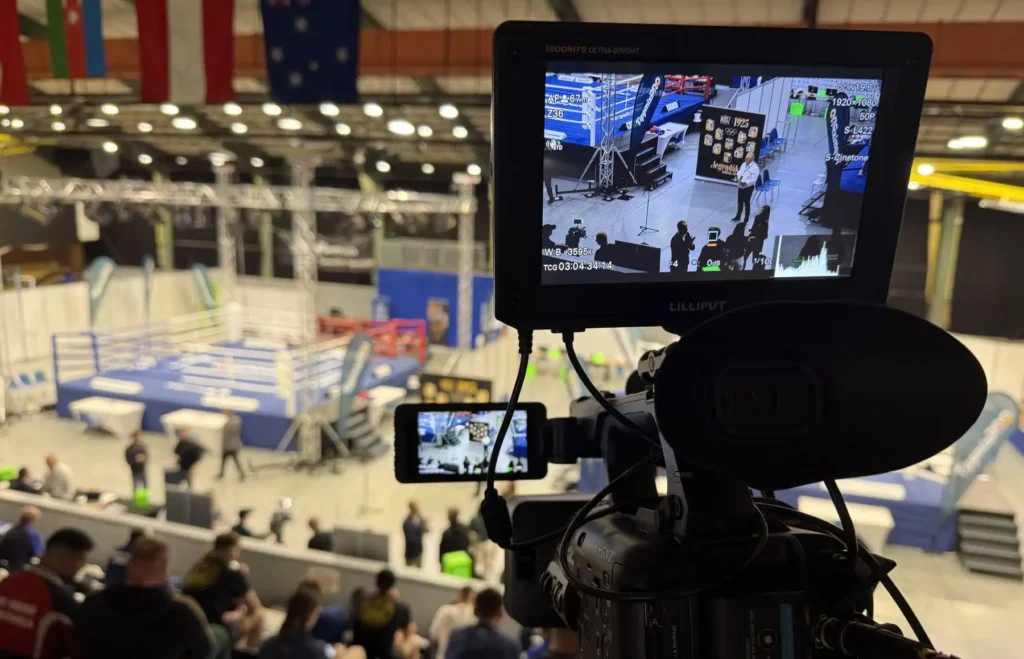
A typical entry-level setup includes: one or two fixed or operated cameras, a basic video switcher or encoding device, simple graphics such as score overlays or lower thirds, and streaming to a single destination (YouTube, Facebook, or a private platform). Deployment is fast, the crew requirement is minimal, and the cost is lower than any multi-camera production tier.
When is entry-level the right choice?
Entry-level works well for: internal corporate streams with a small audience, youth or grassroots sports events, school or club competitions, training session recordings, and informal webinars or announcements. It is also a reasonable choice when an event is being streamed for the first time and the organisation wants to test the format before committing to a higher production level.
Where experience multiplies the value of a simple setup
A single-camera entry-level setup is straightforward. What changes the equation is the ability to run multiple simultaneous productions at the same event — each to the same standard.
Multi-discipline sports competitions often take place across several parallel venues: multiple tatami mats, boxing rings, shooting ranges, or table tennis tables running at the same time. Coordinating separate camera positions, streams, and operators across all of them — with consistent graphics, audio and output quality — requires production management experience that goes beyond the equipment itself.
This is where Pélicom’s background in federation-level broadcast directly benefits smaller productions. We apply the same planning discipline and coordination logic to a four-table table tennis tournament as we do to a European Championship host broadcast. The result is a multi-stream production that looks and runs like a deliberate editorial choice — not like four separate operators doing their own thing.
If your event involves parallel competition areas and you need every one of them covered reliably and consistently, talk to us about a multi-stream entry-level setup.
When is entry-level not enough?
Entry-level production is not recommended for high-profile public events, federation championships, events with broadcaster distribution, or any production where technical failure would have reputational consequences. If your event is being watched by sponsors, media rights holders, or a significant public audience, the limitations of a one-camera, single-operator setup carry real risk.
For events that require consistent, reliable, broadcast-quality output — whether streamed, recorded for broadcast, or distributed to a TV partner — Mid-Level production or OB van services are the appropriate choice.